|
Reviews |
Upcoming Releases |
Discussion Boards |
Staff Dossiers & Blogs |
Studio Info |
Feedback |
All Content...
Most Popular | Best Rated | By Date | Random |
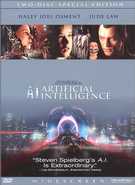
The Charge His love is real…but he is not. Opening Statement A.I.: Artificial Intelligence was misunderstood upon its release in the summer of 2001. It was not, as many bemoaned, a "fairy tale." It did not have a "happy ending." I "eat my own dandruff" (wait…that's Matt Foley). A.I. succeeds at what it set out to do, and in fact suffered from doing such a good of a job pulling one over on the audience. Many people, myself included, were expecting classic Spielberg. Instead, we got what was almost entirely Kubrick, with one crucial element the director himself knew he could never deliver like Spielberg: Heart. The result is a film that feels like the vision Kubrick wanted, with the crowd-pleasing warmth of Spielberg serving as the Trojan Horse for Kubrick's depraved examination of the illusion of love. To dismiss this film after one viewing is akin to dismissing 2001: A Space Odyssey after one viewing. And don't lie. None of us understood 2001 the first time. Facts of the Case A.I. tells the story of David (Haley Joel Osment), the first robot boy programmed with the ability to love. He is an experimental gift given to a couple whose own son has fallen ill. David enjoys his new surroundings, until he finds his function of loving is no longer needed. He is cast aside from the world he loves so much, and spends the movie trying to regain the only thing he was created to understand. His journey takes him through a world in which his kind has become hunted, seen as a threat instead of a service to the humans that created them. David is looking for love, in all the wrong places, and A.I. is a movie with many questions that all lead up to a big one: What is love? (I didn't like picturing the Roxbury guys just now, either.) The Evidence As a warning, this review talks about things that might spoil elements of the movie if you haven't seen it. However, unlike most Spielberg movies (and despite its luscious exterior), this is not a movie about discovering spectacle. Unlike Jaws or Close Encounters Of The Third Kind, it isn't best the first time you see it. It isn't a movie that sets up a question in the first act and answers it; rather, it takes the length of the movie to finish asking, necessitating a second visit. The clues to Kubrick and Spielberg's own answers are all over the film, without ever shoving their way in to the story. Seeing it again on DVD, I'm struck by how much I didn't catch the first time that feels crucial now. The set designs, the deliberate dialogue, it's all laid out like bread crumbs that lead in any and all directions the viewer is willing to go. What it means ends where the viewer's input ends, so that it invites almost endless rumination (much like 2001). It asks the audience to consider what love is to them, and how much they would allow something that feels like love to substitute. Sex, drugs, murder; all of these are, in the end, a replacement for love. If Spielberg movies typically have heart, this is his first film to ask what heart is. It makes the audience wonder why we "loved" the alien of E.T. when he was a latex puppet. And if something artificial could love us back without fail, could we do the same in return? A.I. spends every frame examining these ideas, and they come through even more on DVD. One of the most overlooked things about A.I. was how much it follows the pattern of 2001. Perhaps my lack of familiarity with much of Kubrick's work forced me to draw that comparison. But consider: 2001 begins in the time of purity, before and literally leading up to the dawn of man. It is untouched, peacefully devoid of conflict, and it is abruptly interrupted by a new consciousness that causes the film to hurl forward. A.I. begins in suburbia, our modern societal equivalent to that place of innocence. The suburbs feel like the safest place in the world, where there are simple rules and everyone is just trying to be happy, until a robot gets a rude awakening about man's nature. In 2001, we are jutted quickly from the pure and harmonious to the cold and distant. Space is vast and dark, uninviting and seemingly doomed. In A.I., David is shuttled out of the suburbs to find himself in the frightening wasteland that is the New Jersey rainforest, and eventually Rouge City, which also feels like an endless hole of desolation and decay. In 2001, we are kept almost too long in space, asked to endure agonizingly slow shots to soak in how it feels to live in this world compared to the one in which the film began. Actually, it doesn't ask, it insists. A.I. knows the importance of this difference, and while many complained that the film was too dark, it needed to be. Not dark—too dark. Uncomfortable. The audience wants David to get out of this nightmare, so that they may as well. 2001 ends on a contemplative image that is essential to understanding the entire film that preceded it. A.I. does as well, with an image that, like the fetus shot closing out 2001, seems beautiful and innocuous, but on further examination opens up a Pandora's box of heavy questions the movie had been hinting at all along. Unfortunately, audiences didn't understand the way they had been manipulated into seeing what was easiest to see in the ending. The real idea depicted, however, is completely contrary to how it seems if you take it at face value. The outward lesson is about the fact that what makes people alive is their ability to dream, and to pursue those dreams. I don't find this as sappy as some. Perhaps I'm comparatively more immature than the average bloke, because I found it a touching sentiment in a summer that found me looking fondly upon crapola like Jurassic Park III. When David's goal is finally realized, we are relieved, but where many saw it as a tidy resolution, the end was the dark final section of the film's main questions: Had David found the love he was after, or a substitute? If it felt like it was love, did it matter that it wasn't real? Or was it? The shots at the end have a real warmth in the center of them, yet on the edges there is darkness. It's removed, a simulation. John Williams' score is warm and appropriately fairy-tale inspired, but listen to it loud and notice the low layers of doubt behind every sweet note. It's a sham, and in a way, it must have been bittersweet for Spielberg to watch everyone fall for it more than he planned. If A.I. has a fault, it is this. It does what it does with such nimble subtlety and restraint, that it goes right past most on first viewing, and invites the viewer to bring so much to the table that it would be easy to accuse the movie of not bringing very much itself. But making a piece that can be contemplated over and over, something that stands up to repeated viewing and different perspectives in a way that a film like American Beauty does not, is a real accomplishment. The final section, in a world where people no longer exist and robots are the legacy of man, robots provide David with an artificial recreation of his mother. None of it is human, and this is what makes it so disturbing. Though it feels like a happy ending, when you realize that all of this is going on amongst a bunch of machines for an emotion that has always seemed indelibly human, the darkness of Kubrick's vision becomes evident. I'm convinced that A.I., like 2001, will only be more understood and appreciated with time and perspective. The performances were the shock the first time I saw A.I. Haley Joel Osment failed to affect me in The Sixth Sense until the scene in the car with his mother, when I found myself surprised with his subtle approach to what begged to be a look-ma-I'm-acting scene. He's a real actor, and though it would seem impossible to invest any emotion into such a young boy, he pulls it off. David is cute, but not gratingly so. He only becomes grating when we realize he can do nothing besides love. A source of constant comfort on paper, but creepy in execution, David has been made perfectly and yet is quickly out of step with the people he wants so desperately to please. Is the glitch with David, or the human beings that are threatened by his boundless love? Without having affection for David, it would be impossible to care, but Osment invests himself into David in a way that makes the audience want him to succeed, and his performance elicits more respect on repeat viewing. Jude Law was striking in his Oscar-nominated turn in The Talented Mr. Ripley, where he pulled off the tough task of keeping the spirit of a character alive throughout an entire movie in which he disappears halfway through. That same vitality and energy are on display here. He moves not as a smooth human, or a creaky robot, but as a smooth robot. He feels like the full realization of robot technology instead of a human playing a machine. His presence is also similar to Malcolm McDowell's in A Clockwork Orange, mixing a confident masculinity with a confident femininity. He's sexy, but sexy in the purest way, the way ice cream is sexy. He oozes confidence in his ability to please, without any of the boastful pretense that a human with his charms would inevitably have. He is guiltless mirth built for consumption, an escape from reality into a narrow happiness for those who use him. That selflessness is what sexiness is all about, and Law impresses as much as Osment as he inhabits these aspects of Joe, instead of depicts them. Spielberg's direction is also in top form. I don't know how he manages to still make shafts-of-light shots interesting, but he does. The passage of time and his more serious movies of late can make it easy to forget how talented Spielberg is with telling a story that can exist purely visually. He manages to be grandiose without seeming bloated, and a movie like this displays the light years of difference between his visually oriented contemporaries like Michael Bay. He also manages to pull out some wonderfully low-key performances, and makes a far-off future seem like modern day by taking it seriously instead of trying to impress. The deft direction here makes me very excited for Spielberg's summer flick Minority Report, which has similarly dark futuristic elements. The extras on disc two are refreshingly satisfying and well-rounded. It covers the bases by having documentaries dedicated not only to the visual affects, like most releases of this nature, but also the acting, set design, animatronics, sound, and score. Some of these are excellent, if short, and provide interesting new perspectives on the film. Some docs even have subsection menus which focus on one particular aspect (such as breathtaking New York City sequence). There's a lot to see here, and except for some confusingly chipper Producer-speak from Kathleen Kennedy, everyone's input is fascinating and makes the coherence of A.I. make sense. There is also an interesting final word about artificial intelligence, and our responsibility to it, by Spielberg. However, this only serves to highlight how incredibly weak it is that Spielberg doesn't do commentaries. I understand not wanting to talk about Raiders of the Lost Ark until the time is right. But A.I.? I wish I could hear from him while it's fresh in his mind. Considering the death of Kubrick, the film's spiritual father, you would think Spielberg would feel the necessity to make sure his thoughts were on record. I don't get it, and it's the only reason I can't give the disc a higher extras rating. The visuals and transfer are amazing, of course, and though I was surprised to find edge enhancements in sections, overall it was fantastic looking, especially Rouge City. The mixes both also sound great, though the moon chase and flesh fair sound much better in 5.1. John Williams did a fantastic score that I missed much of the first time around; this mix has me excited for the upcoming E.T. re-release. The Rebuttal Witnesses Gigolo Joe is the one element that you feel Kubrick would have gone much further with. Kubrick apparently wanted some graphic sex scenes for Joe, and I admit that after watching Law's performance, I wished to know more about the sickly sensible idea of a robot prostitute. If David was made to give real love, Joe was made to provide carnal substitution. At the end of the day, is there a difference? This idea could have used much more examination, and watching this film, you can picture Kubrick urging Spielberg to explore this more. Also, while I agree with its debated inclusion, the shot in the very distant future (sort of a play on the famous multi-millennia jump in 2001) that features an underwater New York City with still-standing World Trade Center towers was jolting. Six months ago, it seemed acceptable that thousands of years and complete submergence couldn't shake the foundations of two of our most iconic architectural achievements. To realize the towers would never make it to that future, or even close, was more depressing than I expected. Closing Statement A.I. should, without a doubt, be seen at least twice. If you saw it in the theater, see it again. The ad campaign in a way had us expecting something we didn't get, but if you see it again on its own terms, it's nearly brilliant. It isn't perfect, but it's a lot closer than it got credit for. While it would have been nearly impossible for Spielberg to craft a movie that would be instantly accepted as being on par with a classic like 2001, A.I. succeeds in parallel ways to that film, and is arguably as fully realized. If you saw it and were let down, try it again. During the ending, think about what we're really seeing. The Verdict The court believes in A.I.'s story, and orders a retrial based on mishandling of the evidence last summer. Review content copyright © 2002 Deren Ney; Site layout and review format copyright © Share your thoughts on this review in the Jury Room
Similar Decisions: |

Printer Friendly Version |
||||||||||||||||||||||||||||