
| Home | DVD Reviews | Upcoming DVD Releases | Judges | Legal Briefs | Forums | Site Map |
|
|
|
Case Number 03136
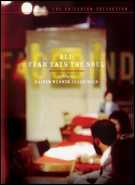
Ali: Fear Eats The Soul: Criterion Collection
Criterion // 1974 // 93 Minutes // Not Rated
The Charge"Fear no good. Fear eat soul."—Ali Opening StatementAli: Fear Eats the Soul was filmed in the two weeks between projects. Fassbinder knew exactly what he wanted to say. He said it, then wrapped. This brevity and intensity of focus leads to a succinct cinematic statement. There is no fat on Ali. As such, it is among Fassbinder's clearest and most penetrating work. Facts of the CaseIn 1970s Germany, a cleaning lady is walking home but gets caught in the rain. Out of curiosity she steps into the bar that she passes every day. Inside she finds a thoroughly foreign crowd and a distinctly cool reception. A handsome Arab mechanic is provoked into dancing with the old woman as a form of mockery. To their mutual surprise and the shock of onlookers, Ali and Emmi enjoy each other's company. They become a couple and have to face the societal ramifications. Their prosecution ranges from oblique to blatant. The two seek happiness in a world that will not let them rest. The EvidenceI have never been more viscerally excited by the mechanics of camerawork. Fassbinder composes each shot with such exactitude that meaning is intensified. The story seems slightly raw and unpolished, but the compositions and direction are so sure that you know you're viewing true art. In one example, Emmi and Ali are standing in the stairwell in her apartment building. Emmi is in the foreground, Ali holds the middle, and the door is in the background. Emmi is talking, more to herself than anyone, about loneliness and comfort. As she convinces herself of Ali's worth, the camera slowly brings him into focus. We see Ali more and more clearly as he enters her consciousness. She talks about herself for a moment and the focus goes back to her. Then, as though an internal restraint had been lifted, both figures come into clear focus as they walk upstairs. Fassbinder continually reinforces the couple's isolation by framing them in cramped shots. The claustrophobia induced by the camera helps us share their discomfort and oppression. Alternatively, he uses deep focus with Ali and Emmi in the foreground and an unmoving crowd at the far end of the shot, staring in stony silence. This technique emphasizes emotional distance between Emmi and the rest of German society. Creative and meaningful compositions make Ali a visual treat. Camerawork is not the only draw. Emmi is portrayed by a great German actress, Brigitte Mira. She exudes an impressive array of moods and emotions, each more convincing than the last. At 89 minutes, Ali is somewhat short, but it does not feel that way. Mira runs the gamut from euphoria to desperation, and we feel with her at every turn. Incidentally, Mira gives an interview for the DVD, and she has to be the most lucid ninety-something I've ever heard. Brigitte Mira is the biggest name attached to Ali (if you exclude Fassbinder's powerful cameo), but the other lead is convincing as well. El Hedi ben Salem gives Ali a stoic approachability. He is serious but displays a great sense of humor. His moments of desperate frustration lend realistic dissonance to their relationship. El Hedi ben Salem was R.W. Fassbinder's lover at the time of filming. This dynamic gives greater personal meaning to the work; it is easy to project into Ali Fassbinder's frustration at the German reception to his interracial gay relationship. In fact, Rainer's character in Ali kicks in a television set in protest to his mother's relationship. Perhaps his startling animosity was an expression of true hostility? The image quality of the DVD is on par with other Criterion releases. There is no edge enhancement or perceivable digital noise reduction. The 30 year old print is mildly faded, but the colors seem bright and the blacks deep. There were occasional nicks in the film, but I will take that any day over artificially-induced artifacts of DVD mastering. The audio is serviceable, if spartan. Unless you speak German, you are getting the dialogue through the subtitles, and there are only a couple places where songs or sound effects make the point. Ali is primarily a visual treat. Criterion has loaded Ali with extras. All are worthy (if tangential) offerings, but two stand out. The first is the short film Angst isst Seele auf from 2002. Brigitte Mira returns in the role of Emmi, immediately connecting us to the vibe of the 1974 film. The message is similar as well. In spirit, however, the short film is darker and more violent. The entire short is in first person perspective, so we feel firsthand the menace of physical and emotional assault. What it lacks in comparison to Ali's tenderness, it makes up in the direct brutality of persecution. The second notable extra is a trio of interviews with actress Brigitte Mira, editor Thea Eymesz, and director Todd Haynes. Each informs us of how Fassbinder influenced their work. We are treated to three perspectives from which a cohesive view of Fassbinder emerges. By all accounts, he was a focused, motivated filmmaker with firm self reliance. The Rebuttal WitnessesThe ending is a red-headed stepchild. There are scant connections to the previous commentary, but it feels somewhat arbitrary. As a revelation it fares poorly, as a statement it is mediocre. The ending does not spoil the film, but R.W. didn't save the best for last either. Closing StatementThis unassuming melodrama is more powerful than it seems. Fassbinder tells the tale with such immediate facility that the plot almost seems irrelevant; you could watch it for the craftsmanship alone. Ali is a cohesive jewel with an undercurrent that stays with you long after the credits roll. It seems that Rainer captured a piece of truth when he shot Ali: Fear Eats the Soul. The VerdictFor crafting a provocative statement on prejudice, R. W. Fassbinder and company are free to go. Thanks to Criterion for yet another stellar package. Similar Decisions
• True Colors Give us your feedback!Did we give Ali: Fear Eats The Soul: Criterion Collection a fair trial? yes / no Share your thoughts on this review in the Jury Room |
|
Support DVD Verdict | Promote your release | Privacy policy | Manifesto | Contact us
Review content copyright © 2003 Rob Lineberger; Site design and review layout copyright © 2007 HipClick Designs LLC. All rights reserved.

![[printer friendly]](/images/printer1.gif)