|
Reviews |
Upcoming Releases |
Discussion Boards |
Staff Dossiers & Blogs |
Studio Info |
Feedback |
All Content...
Most Popular | Best Rated | By Date | Random |
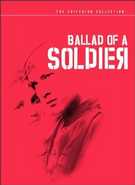
The Charge "We will tell his story, a story not everyone knows—not even her, his mother." Opening Statement Grigori Chukhrai's tender, touching masterpiece is, at first glance, deceptively simple: a young man, a young woman, his mother, and the human toll of war. But real life isn't quite that simple, nor is this beautiful film. Facts of the Case A woman (Antonina Maximova) stands staring down a long, solitary dirt road. From the narration we learn this road connects a tiny Soviet hamlet to the outside world, but that world is far away, beyond the horizon. Of the woman the narrator says, "She's not waiting for anyone." She used to wait for her son Alyosha, but he did not return from the Great War. His body lies beneath foreign soil in a strange, distant land where people he never knew lay flowers on his grave. But we know Alyosha (Vladimir Ivashov). He is the nineteen-year-old signalman who radios from his foxhole on the Russian front, "I see tanks." Unfortunately for Alyosha, they see him too. The German tanks chase the terrified tenderfoot across a desolate battlefield until he stumbles upon a grenade launcher and fights back, destroying two of the deadly machines and putting their surviving comrades to flight. The young private returns to the command base, where he is lauded as a hero. "I was afraid," he confesses to his battle-scarred general (Nikolai Kriuchkov); "I wish everyone was so afraid," the veteran leader says. The general wants to award Alyosha a medal, but the soldier has an alternative request: to return briefly home to help his mother, whose latest letter indicates that the roof of their house is leaking. Of course, all the soldiers would like to go home, but they have a war to fight. Alyosha, though, has earned with his accidental heroism some special consideration. The general grants him six days' leave: two days for the journey each way, and two days to repair the roof. Perhaps the older man sees a long-lost part of himself in the fresh-faced earnestness of this boy. For the remainder of the film, we travel with Alyosha—by passenger train, by hay-filled boxcar, by rattletrap jalopy, and on foot—on the torturous road to his village. Along the way, he encounters others whose lives are being torn by the conflict: a comrade-in-arms who wants to send a gift of two cakes of soap home to his wife, through whose town Alyosha must pass; another soldier (Yevgeny Urbansky) returning home from the war minus one leg and a fair portion of his masculine dignity and self-worth; a sleepy old woman who gives Alyosha a ride during a driving rainstorm; a wife and a father both connected to the same soldier at the front, but whose relationships with that man are pursuing tragically divergent courses. But most memorably, Alyosha meets a lovely young woman named Shura (Zhanna Prokhorenko), who like him is traveling catch-as-catch-can to visit her fiancé. In the fleeting hours the two share together, they fall…well, not quite in love, for true love, like Rome, is never built in a day, but in a wistful, golden attraction that might have become love were it not for the ticking clock that speeds Alyosha on his errand home. Does Alyosha get back to his mother? It spoils nothing, really, to say that he does, for a single heartrending moment in the midst of an unstoppable force called war. This is a journey that isn't really about the destination, but about the journey itself, and the young man who takes it, and the girl he meets but cannot keep, and the mother who loves him but does not yet know what we have known since the film began: that this most momentous trip of her precious son's life will also be his last. The Evidence Ballad of a Soldier was a product of the "thaw" that followed the end of Josef Stalin's ham-fisted rule over the Soviet Union. For the first time since the Bolshevik Revolution, artists in the late 1950s and early 1960s were permitted to open the tiniest slit in the Iron Curtain and share their visions with the Western world. Grigori Chukhrai was the rare Soviet director who shrugged off, at least in large measure, the state-sponsored mantle of art as propaganda and told simple, human stories unencumbered by the weight of Party politics. Chukhrai's characters are still symbols, but they are people first. In a subtle yet radical break from the conventions of the day, Chukhrai shows us Soviet citizens who are anything but archetypes of nobility and virtue: the venal security guard who extorts food from Alyosha in exchange for passage on the train is one example, as is the army wife whose lover is keeping her bed sheets warm while her husband risks his life defending their country. Even Shura is shown to be duplicitous toward Alyosha, if only mildly so. (Significantly, Alyosha is described as a "Russian" soldier rather than as Soviet.) These may seem like trivial points to you and me, but in the Soviet cinema of the post-war period the very notion that citizens of the USSR could be anything but stolidly upstanding and righteous was an alien concept. The running dogs of capitalist democracy might well be portrayed in a bad light, but never the home folks. Chukhrai gets away with it here. Because they are (relatively) free to be three-dimensional characters rather than scarecrows, we empathize with Alyosha and the people he meets on his trip. We can admire Alyosha's kindheartedness toward everyone because we see that he does, in fact, have a heart. Likewise, we fall in puppy love with Shura right alongside Alyosha because we sense that she is a real young woman—fearful of telling the complete truth to this unknown but fascinating man in uniform because she isn't certain she can trust him. Yes, Alyosha always does the noble thing: accepting errands from total strangers, helping the handicapped, showing righteous indignation toward the adulterous wife and compassion for the ailing father, never letting anything—including a beautiful girl—stay him from his appointed rounds, from his ultimate goal of mother and home. But he does all these with credible motivations, as a nice, well-mannered boy and not a propaganda puppet. The reality of these people makes us all the more sorrowful for their war-crippled (literally and metaphorically) lives and land. Chukhrai exacts winning performances from his neophyte stars. Vladimir Ivashov is appropriately handsome and open-faced as Alyosha. He carries his character's essential goodness with such boyish charm that he never seems saccharine, and we root for him to complete his mission despite the fact that we know from the start he's living on borrowed time. Zhanna Prokhorenko, though given little of actual import to do in the script, is a revelation, with eyes like a waif in a Keene painting and a lush-lipped smile any red-blooded young man would wrestle a bear—or chase a train—to view. The black-and-white cinematography by Vladimir Nikolaev and Era Savelyeva is gorgeous and surprisingly active for a film from this period; the camera draws us into each scene and makes it pulse with life around us. The sequence in which Alyosha and Shura take their last train ride together is the emotional and visual equal of anything I've seen from modern Hollywood—the girl's long tresses swirling in the rushing air, caressing the face of the boy…stunning, and more passionate than the kiss that they never exchange. Criterion, the obscure classic's best friend, does a stellar job in presenting Ballad of a Soldier. The full-frame transfer, representing the film's original aspect ratio, has been lovingly restored and is amazing in its spotlessness. Some grain and print damage would be understandable, even acceptable in a film of this age and origin, but the DVD crew at Criterion has digitally buffed and polished this jewel to a pristine sheen. My only—pitifully nitpicky—quibble is with the occasional softness of the grayscale contrast; blacks could be blacker and brighter tones brighter, but again, this is a minor issue. Criterion, as on several of their other discs, includes color bars so the viewer can adjust his or her screen settings for best effect. The soundtrack, likewise, has been shown the royal treatment. Only the slightest of ambient tape hiss is detectable here, and none of the crackling and popping you'd expect in a four-decade-old recording. Mikhail Ziv's score sounds marvelous, and is stylistically appropriate throughout the film. The original Russian dialogue is supplemented by English subtitles. Only one item of added content has been included on this disc: an audio interview conducted with Chukhrai, Ivashov, and Prokhorenko by radio personality Gideon Bachmann on the radio program Film Art following a New York preview screening of Ballad of a Soldier. I have no idea who Gideon Bachmann was or perhaps is, but as one who studied journalism in my misspent youth, I know he violates every principle of sound interviewing in the space of this 15-minute segment. He interrupts constantly—especially annoying because he's making life miserable for the translators—asks patronizing questions, ignores the answers to the questions he asks, and basically demonstrates what a self-important prima donna he is. I was embarrassed for the director and his young actors, who doubtless left the restaurant (the interview was broadcast from the Four Seasons) thinking, "It's true what the Party says about these bourgeois American pigs." Give Criterion major kudos for turning up this little nugget, and for dressing it up with stills from the film and subtitles, but it's too bad it's not worthy of the film under discussion. The Rebuttal Witnesses As tragic as it is to imagine artists such as Grigori Chukhrai laboring under an oppressive regime that stifled creativity, it is still more tragic to recognize how many of today's American film fans will disdain extraordinary pieces of cinema like this one for Neanderthal reasons: it isn't in color, it isn't in English, and there's no real action after the first brief battlefield sequence. Wake up, people—there's a whole wide world of film out there. Some of it is older and less flashy than the umpteenth Jurassic Park sequel. Some of it was created by people whose native tongue and culture is different from yours. Some of it has genuine thought and emotion in it, and mature stories to tell. Break away from your Tom Green toilet humor fixation for an afternoon, kids, and try something intellectually stimulating for a change. Closing Statement Deserving of every ounce of attention the fine folks at Criterion devoted to its restoration, Ballad of a Soldier merits repeated savoring with someone you cherish. It will remind you of your mother, your first love, and the bitter evil called war that human beings perpetrate against one another. You will want to take kind Alyosha or sweet Shura home with you—I'll let you decide how that choice plays out. Fondly recommended. The Verdict Any potential court-martial of this soldier is thrown out of court. Case dismissed! Review content copyright © 2002 Michael Rankins; Site layout and review format copyright © Share your thoughts on this review in the Jury Room
Similar Decisions: |

Printer Friendly Version |
||||||||||||||||||||||||||