|
Reviews |
Upcoming Releases |
Discussion Boards |
Staff Dossiers |
Studio Info |
Feedback |
All Content...
Most Popular | Best Rated | By Date | Random |
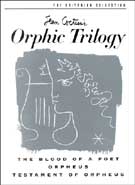
The Charge "Every poem is a coat of arms. It must be deciphered." Opening Statement Setting out to make "a realistic documentary of unreal events," Jean Cocteau reaches deep into his psyche to pull together a dream-like exploration of the role of an artist in a world where art is merely passing entertainment. No film artist has ever been so successful at capturing the ethereal mystery of dreams as well as Jean Cocteau. The first film in what is loosely known as Cocteau's "Orphic" trilogy (named for his 1949 masterpiece, and I do not use that word lightly, Orpheus), Blood of a Poet is Cocteau's attempt to survey the terrain inside his own head and translate it to film. Tremendously influential (contemporary surrealists like David Lynch borrow from Cocteau constantly) and hypnotically fascinating in its own right, Blood of a Poet is well served by the signature Criterion treatment. Facts of the Case Episode I: A young artist (Enrique Rivero) in an attic room sketches his own face. The mouth on one of his sketches comes alive and tries to speak. Terrified, he rubs it out, only to receive a stigmata: a mouth appears in the palm of his hand. Unable to satisfy its cries for air, he puts the hand to his mouth, then runs it along his body. The next morning (as an image of a double-sided mask spins to reveal its inside), Jean Cocteau himself announces in a signed note on screen, "I got caught in a trap by my own film." The artist's hand whispers to him in his sleep. The sleeping artist opens his eyes, and desperate to rid himself of his stigmata, transfers the mouth to a nearby statue (Lee Miller), which awakens from its "secular sleep," only to send the artist through a mirror on the wall on a hallucinatory trip into his own past. And that is just the first episode! The Evidence Trying to explain Blood of a Poet is like trying to explain a dream. Or more appropriately a poem. We could consult Freud and Jung and offer "psychological" explanations. We could analyze and explicate the metaphors, talking about the problem of language itself. But there is always something more to Cocteau's films than the simple reductionism of ordinary interpretation. There are those haunting images: characters flying through mirrors, struggling to walk along walls and ceilings, rising up from death. Yes, we know these are elementary special effects that anyone with a camera could do: the mirrors are pools of water, the walls are sideways sets with actors crawling along the floor, the resurrections are accomplished by running the film backwards. But Cocteau manages to always make them look surprising, as if we are watching our own dreams unfold before us. I have seen three earlier prints of Blood of a Poet (one in 16mm and two on video, none with subtitles), and Criterion's restoration work is nothing short of miraculous. Still a bit soft and silvery in places, and with a few scratches here and there, the print is easily in the best shape it has ever been. Georges Auric's oddly bouncy score sounds crisp, with a minimum of hiss on the soundtrack. Because the print is presented in its original aspect ratio of 1.33:1, the subtitles must overlap the bottom of the image, and although I would have preferred yellow titles over the black-and-white image for clarity's sake, the translations are well done and easy to read. The film runs a brief 50 minutes, broken by Cocteau into 4 episodes (the disc uses 5 chapters, including the credits sequence). But Criterion, as always, packs in the goodies. A photo gallery (usually fluff on most discs, but Cocteau was an artist in so many areas that his photography stands on its own). Two essays by Cocteau himself discussing the film, one from 1946 (reprinted on the insert) and one from 1932 (on the disc). The 1932 essay is the most illuminating, but both are welcome additions to the film. Although Cocteau only briefly offers his own interpretation of the film (admitting that it is only one possible reading), he does offer an intriguing and unpretentious glimpse into the artistic process. Anyone who finds Blood of a Poet "too highbrow" will benefit from Cocteau's own thoughts about filmmaking: he reveals how the special effects were done, admits that he made up his film technique as he went, and is generous toward his artistic collaborators. The most striking addition by Criterion is a 1984 documentary on Cocteau by Edgardo Cozarinsky, entitled "Jean Cocteau: Autobiography of an Unknown." Clocking in at over an hour (longer than the Cocteau feature itself) it offers a surprisingly warm look at the artist himself. Cocteau chats amiably about his childhood, his treasured influences, and his artistic contemporaries (to whom he is quite generous). Cut together with scenes from Cocteau's films, his sketches and sculptures, and interview footage, the documentary (in black-and-white and color) shows Cocteau as a hands-on artist, who likens his technique to "jazz improvisation:" "I don't like the idea of poetry. I like poetry itself." Cozarinsky's film is worth the price of the DVD itself, and Criterion is to be commended for packaging it together with Blood of a Poet to give a thorough sense of Cocteau's importance as a figure in 20th century art. The Rebuttal Witnesses If you can't stomach "artsy" movies, you will likely not enjoy Blood of a Poet. Cocteau's approach to the problems of being an artist may strike many as rather narcissistic and bordering on a martyr complex. But Cocteau's own words on the subject (evidenced in the two essays and the documentary discussed above) show that he had a sense of humor about his own work. Even he understands that this film is an experiment, a risky attempt to translate mental images onto film. You will not find much clear narrative in Blood of a Poet, as Cocteau opts for a more associative, imagistic approach to filmmaking here. But those images will stick with you. Closing Statement Those of us who write film criticism like to chatter a lot about what we call "art," but few filmmakers earn that title quite as aptly as Jean Cocteau. While not as accessible as his more well-known Orpheus and Beauty and the Beast, Blood of a Poet, available by itself or as part of Criterion's "Orphic Trilogy" boxed set, provides a haunting look into the artistic process. And the Cozarinsky documentary included with the film makes this an indispensable disc for any collector interested in surrealist art in general. The Verdict The poet may condemn himself, but the court can find no cause to detain him any further. Jean Cocteau and Criterion are released. Glory to the poet! Review content copyright © 2000 Mike Pinsky; Site layout and review format copyright © Share your thoughts on this review in the Jury Room
Similar Decisions: |

Printer Friendly Version |
||||||||||||||||||||||||||