|
Reviews |
Upcoming Releases |
Discussion Boards |
Staff Dossiers |
Studio Info |
Feedback |
All Content...
Most Popular | Best Rated | By Date | Random |
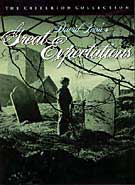
The Charge "In trying to become a gentleman, I had succeeded in becoming a snob." Opening Statement In 1946, after four successful films in collaboration with Noel Coward, David Lean turned his attention toward another master critic of English morals: Charles Dickens. Streamlining the sprawling narrative to fit two hours, Lean succeeds in constructing what may be the best adaptation of a Dickens novel yet filmed. Facts of the Case Along a desolate field marked with empty gibbets, young Pip (Anthony Wager) runs to visit the grave of his parents. He is surprised by an escaped convict (Finlay Currie), who demands aid. Pip, an orphan living with his abusive sister and her sincere but simple husband, brings the convict some food and a file to saw off his irons. While the grateful convict eats his desperate meal, soldiers hunt for him. On a beach in twilight, the convict is captured, but he covers for Pip and claims he stole the food and file himself. One year later, Pip is summoned to the decaying estate of Mrs. Havisham (Marita Hunt) and her imperious adopted daughter Estella (Jean Simmons). Time has stopped here: the years-past-jilted Mrs. Havisham keeps her world exactly as it was on the day her lover abandoned her. She orders Pip to play. Estella is programmed to seduce and destroy men. Even a boy Pip meets one day on the grounds picks a fight not, not because he is angry, but because it is the thing boys must do. Several years later, after Pip has long left Mrs. Havisham's to apprentice as a blacksmith, Mrs. Havisham's lawyer Jaggers comes to bring the young man (now played by John Mills) to London. A mysterious patron has offered to help Pip become a "gentleman of great expectations . . ." The Evidence In his first project free from the constraints of Noel Coward, Lean chose to put himself under a new set of restraints: adapting a sprawling classic by Charles Dickens. Cutting out numerous subplots and tidying up the ending (which often looks tacked on when translated faithfully to film, since it jumps a decade ahead and often requires awkward exposition), Lean takes advantage of his skills as a film editor to give the nearly twenty-year span of the plot an almost breathless sense of flow. Take one classic example: Lean segues from Magwitch's meal in the foggy graveyard to a group of sardonic dinner guests at Pip's house (two meals, each the reverse of the other). A guard captain enters to enlist Joe's help in tracking the escaped prisoner, and Lean shifts to lines of soldiers (accompanied by Joe and Pip) moving through the foggy landscape. We follow the visual motion of the soldiers to the beach, where Magwitch is found struggling with a fellow prisoner. With Lean's use of the moving camera paired with visually compatible, we move briskly through the action. Strong performances also hold the narrative together, particularly the transition from Anthony Wager to John Mills as Pip. In many films where child actors are replaced with adults, the audience may feel disoriented by the shift. Anthony Wager turns in a remarkable performance for the short time he is on screen, communicating both Pip's childish innocence and his growing sharp intellect. The best modern comparison I can think of here would be Haley Joel Osment: he acts like a kid, but there is something wise behind those eyes. From Wager, the film jumps ahead six years to introduce us to John Mills, who plays Pip at first with the same childlike innocence, which by the film's climax gives way to a haunted and more resonant performance. The rest of the cast is also uniformly excellent. Keep an eye out for a young and perky Alec Guinness as Pip's best friend Herbert Pocket. Guinness would come into his own as a major star in Lean's next film Oliver Twist. Criterion's transfer of the film is excellent. Although a few specks and scratches appear, the black and white image glows in wonderful fashion, with every small detail visible. And this is certainly a film where details count. Take a look at Jaggers' office, with its death-masks and nooses hanging on the wall: is this lawyer friendly, or does he hide dark secrets? Special mention should be made of Lean's use of sound in Great Expectations. Criterion presents the original mono soundtrack, which is quite clear and free of hiss. Lean uses the sound effectively not only to generate atmosphere, but to tie scenes together much like visual editing. The wind and creaking noises that permeate the otherwise silent opening shots give a sense of foreboding, like a horror film. Compare this with the later scene of Pip, Herbert, and Magwitch waiting silently in the empty boathouse as wind and creaking noises wash over the soundtrack. The Rebuttal Witnesses Supplemental material is rather thin here: a theatrical trailer and an essay on the insert. Both are quite nice, but with so much importance placed in the essay on Lean's mastery of editing technique (especially in the opening scenes of the film), a commentary track by a film scholar would have been a welcome addition. In order to pare the novel down for a two-hour film, Lean did have to take a few liberties with the story. And he changes the ending just a bit to bring the narrative full-circle (part of his attempt overall to tie all the elements of the film together). However, this version still holds up marvelously, especially compared to the six other film versions (my wife is partial to the recent BBC adaptation with Ioan Gruffudd as Pip; and I strongly recommend avoiding the mangled 1998 update with Ethan Hawke). I must admit that I have never been much of a Dickens fan (he gets a bit sentimental for my tastes), and his "coming-of-age" novels often seem to bring out the worst melodramatic excesses in directors. But at his best (and often most cynical), Dickens is a master of social critique, and Lean takes a cue from his successful work with Noel Coward on Blithe Spirit and Brief Encounter: avoid sentiment and stay focused on details. Closing Statement Great Expectations is at its heart a story of the tension between social obligation (our "expectations" in society) and true ethics (our "expectations" of a bright future). Pip stands between two worlds: the rigidly "proper" realm of Mrs. Havisham, where time never moves and everyone preys on one another, and the ironic freedom of Magwitch, condemned by society yet always independent—and the one with whom the true gift might be exchanged. David Lean truly comes into his own as a director with this film, probably one of the most successful literary adaptations ever made. If you have a soft spot for literature on film, I highly recommend this disc. The Verdict Since virtue is rewarded and evil punished at the end of the story, this court can only uphold the sentences Dickens himself passed. David Lean and company are fully acquitted. Review content copyright © 2000 Mike Pinsky; Site layout and review format copyright © Share your thoughts on this review in the Jury Room
Similar Decisions: |

Printer Friendly Version |
||||||||||||||||||||||||||