| Home | About | Blu-ray | DVD Reviews | Upcoming DVD Releases | Contest | Podcasts | Judges | Jury Room | Contact |
|
|
|
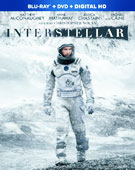
All Rise...Judge Erich Asperschlager is the fifth dimension. The Charge"Do not go gentle into that good night." Opening StatementChristopher Nolan is a filmmaker I have enjoyed mostly from a distance. Even his best films leave me dazzled but emotionally cold. The mixed reactions to his latest, Interstellar, made it an easier decision to avoid the logistical acrobatics of finding three hours of free time to see it in the theater. Now that it's out in a stunning Blu-ray set, I regret that decision. I sat down with Interstellar mildly curious and finished completely entranced. I won't claim it's Nolan's best, but it worked on me more than his other films. Facts of the CaseSometime in the future, overpopulation and ecological crisis have forced the majority of Earth's citizens to become farmers, a shift that has led to massive dust storms and respiratory illness. Pilot-turned-corn farmer Cooper (Matthew McConaughey, True Detective) stumbles upon a way to save the world when a mysterious phenomenon in his daughter's (Mackenzie Foy, The Conjuring) room leads him to a secret NASA base run by a scientist named Brand (Michael Caine) who has been scouring distant galaxies for humanity's new home. Cooper agrees to join the interstellar expedition, along with Brand's daughter Amelia (Anne Hathaway), two male scientists (David Gyasi, Cloud Atlas; Wes Bentley, American Beauty), and a sentient robot named TARS (voiced by Bill Irwin, Rachel Getting Married). The EvidenceIn this world of reboots, remakes, and formulaic filmmaking, any movie that shows us something new is worth watching. Though Interstellar is not entirely original—drawing from ancient mythology as well as the scope, pacing, and world building of Kubrick's 2001: A Space Odyssey—its great achievement is translating speculative deep space science into a travelogue of places none of us will ever see. Christopher Nolan and his brother Jonathan drew from a variety of sources to build their worlds, but most of their help came from renowned theoretical physicist Kip Thorne. Thorne guided their understanding of relativity, gravity, and time. He also developed mathematical models for a visual depiction of the wormhole and black hole that play a huge part in the story. When push comes to shove, Interstellar favors narrative impact over scientific accuracy, but the attention to detail grounds its fiction in science. The freedom of theoretical physics gives Nolan leave to imagine impossible planets that could very well exist thousands of light years away. They are the outer space equivalent of the deep ocean beasties that intrigued and haunted me as a child. I love this stuff. I can understand why the basic Nolan-ness of Interstellar might turn off some viewers—the precision, the exposition, the obsession with detail—but it drilled deep into my brain. The film sparks the same wonder that drew me from a young age to stories of exploration and the unknown. It also taps into my feelings as a parent, focused not only on my kids' immediate well-being but also concern for their future. Nolan pushes those parental concerns to the extreme by handing his protagonist father a world on the brink of collapse, and the tools to save it as long as he is willing to leave his children and watch from many light years away as they fast-forward into adulthood. It's an exaggerated depiction of the way parents feel their children grow up too fast—a measurable phenomenon writ large on a 70mm canvas. The science is fascinating and the world is richly detailed, but the performances are the heart of Interstellar. The screenplay isn't subtle about its themes, but the universality of the characters' fears, struggles, and triumphs gives the film emotional heft even when the storytelling is a little too on the nose. Matthew McConaughey and Anne Hathaway turn in a pair of powerful core performances. Cooper's motivation is balanced between the need to save his kids and a passion for exploration. Amelia's motivations seem more scientific, though later revelations show that they are both driven by love. Whatever you think of the film's approach to "love" it's refreshing to see a Nolan film that leaves room in its clockwork precision for emotional ambiguity. It's also refreshing to see a female role that is more than just expository. Two, in fact, with the introduction of Jessica Chastain's character midway through the film. Chastain is given fewer emotional notes to play, but she plays a key role in the final act. While watching Interstellar at home isn't the same as seeing it on the big screen, its Blu-ray incarnation is scaled down in size only. Like the The Dark Knight films, Interstellar seamlessly shifts between the 2.40:1 ratio of 35mm footage and a screen-filling 1.78:1 for IMAX sequences. Plenty of less ambitious movies are presented in 1.78:1 but the shifting image somehow makes the common aspect ratio seem grander—even when Nolan devotes the expensive film format to something as mundane as wind-blown corn fields. Whatever the size or subject, Interstellar looks spectacular in hi-def. Nolan's stubborn refusal to abandon film pays off in a stunning, detailed image. Interstellar's audio mix got some flak during its theatrical run. There are certainly moments where dialogue is secondary to atmospheric effects and music, but nothing about the Blu-ray's 5.1 DTS-HD Master Audio mix seems accidental. Just apologize to the neighbors in advance and crank the volume to appreciate the mix's full range, which goes from the quietest whispered lines to explosive rocket fire, backed by Hans Zimmer's gorgeous, haunting score. Sifting through the three-plus hours of Interstellar bonus features (all on a second Blu-ray disc) reminded me of last year's hi-def release of Gravity. Where Alfonso Cuaron's film dazzles with its cutting-edge use of CGI, Nolan's space story becomes even more spectacular when you see just how much work went into building it—from constructing full-size spacecraft and planting hundreds of acres of corn, to employing a physicist to guide their depictions of theoretical phenomena no one has seen in real life. You can knock Christopher Nolan for many things, but attention to detail isn't one of them. • "The Science of Interstellar" (50:21): Matthew McConaughey narrates this Discovery Channel special about the real and theoretical science propping up the film, including relativity, the search for inhabitable planets, black holes, time travel, and the exploration possibilities of wormholes. The remainder of the on-disc bonus features are collected under the title "Inside Interstellar," sadly without a "play all" option: • "Plotting an Interstellar Journey" (7:50): Part introduction, part overview of the film's development and production. • "Life on Cooper's Farm" (9:44): A tour of the film's main Earth location, including the challenge of planting a corn field in a place it was never meant to grow. • "The Dust" (2:39): This featurette examines at the very-much-not-CGI dust storms created for the film's early scenes. • "TARS and CASE" (9:27): A look at the design and creation of the film's robot companions, a combination of puppeteering and digital effects. • "The Cosmic Sounds of Interstellar" (13:41): Composer Hans Zimmer talks about his inspirations for the ethereal score, with footage from the recording sessions in a London cathedral. • "The Space Suits" (4:31): The form and function of the film's most important costumes. • "The Endurance" (9:24): Most movies would rely on digital effects for space sets. Nolan built a big chunk of the massive ship as a curved set on hydraulic rockers. • "Shooting in Iceland: Miller's Planet, Mann's Planet:" How the varied and exotic landscape of Iceland acted as stand-in for the film's far distant planets. • "The Ranger and the Lander" (12:20): The process of conceiving, designing, and building large-scale versions of the spacecraft. • "Miniatures in Space" (5:29): A closer look at the scale models used to bring the Endurance to life. • "The Simulation of Zero-G" (5:31): The film's weightlessness effects—courtesy of a complicated harness set-up, with movement consultation by a real astronaut. • "Celestial Landmarks" (13:23): How Kip Thorne's equations helped create the wormhole and black hole effects, and the use of digital projection to extend the spaceship sets. • "Across all Dimensions and Time" (9:02): The mathematical, logistical, and storytelling challenges of the Tesseract set. Yes, it was an actual set. • "Final Thoughts" (6:02): The major players weigh in on the themes and lasting ideas of the film. • Trailers: Teaser (1:53), Trailer 1 (2:34), Trailer 2 (2:35), Trailer 3 (2:29) • DVD copy • Digital copy (redeemable through iTunes, Ultraviolet, or Google Play) • A collectible frame from a 70mm IMAX print of the film. Frame content varies from set to set. My frame is a grimacing Matthew McConaughey in 2.40:1. In case anyone wants to trade. Closing StatementInterstellar clearly isn't for everyone, but for those open to Christopher Nolan's meticulous spectacle, it offers a glimpse of the future that looks beyond our planet. The film works as a broad human drama as well as a visualization of complex theoretical physics. Folks may argue its scientific accuracy and emotional honesty—I had no problems with either—but the amount of effort Nolan, his brother Jonathan, Kip Thorne, and an army of creatives put into researching, writing, building, and filming this story grounds it in a reality that makes its ideas even more awe-inspiring. Fans who marveled at it in theaters will enjoy it on a slightly smaller scale at home, in a Blu-ray package that includes pristine audiovisuals and a three-hour look behind-the-scenes. The VerdictFar out. Not guilty! Give us your feedback!Did we give Interstellar (Blu-ray) a fair trial? yes / no Other Reviews You Might Enjoy
• Stargate: Special Edition |
|
DVD | Blu-ray | Upcoming DVD Releases | About | Staff | Jobs | Contact | Subscribe | | Privacy Policy
Review content copyright © 2015 Erich Asperschlager; Site design and review layout copyright © 2015 Verdict Partners LLC. All rights reserved.