|
Reviews |
Upcoming Releases |
Discussion Boards |
Staff Dossiers & Blogs |
Studio Info |
Feedback |
All Content...
Most Popular | Best Rated | By Date | Random |
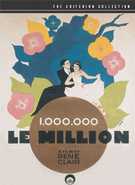
The Case Editor's Note: This review is excerpted from Judge Barrie Maxwell's Precedents column, René Clair: Three Releases in the Criterion Collection. For more details on the film, please refer to the column. Clair's second sound film is certainly the most entertaining and "commercial" of his early efforts. It is structured mainly in the form of an operetta with numerous bits of funny business that overall make it a delightful experience to sit through. The story revolves around a winning lottery ticket that has been left in the pocket of an old jacket. The jacket belongs to a struggling artist named Michel who has given it to his girlfriend for mending. She, however, has lent it to a thief on the lam from the police. Eventually the chase for the jacket ends up in an opera house where "Il Trovatore" is being performed. As in Sous les Toits de Paris, the story is conveyed by song, but even more successfully in this case, although that may be partly due to the fact that the film just has less of a contrived musical feel to it overall. One can certainly see in Le Million the inspiration for the types of musicals that directors such as Rouben Mamoulian and Ernst Lubitsch would soon thereafter be making in Hollywood. Even the antics in the opera house are clearly an influence on the Marx Brothers' A Night at the Opera. Some of the business that Clair gives us is actually quite surprising. For example, one scuffle over the jacket in the opera house turns into what for all the world looks like a football scrum—something that Clair reinforces by introducing the sounds of a crowd at a football game. The Marx Brothers would have been proud, one suspects, to have thought of that themselves. Clair's uniquely creative use of sound is again on display—sounds that are used asynchronously so that they reinforce or add an alternate perspective to events rather than just duplicating what we see. The scene in which Michel and his girlfriend are hiding in a part of one of the opera sets while in another part, two opera singers are belting out a duet, is typical of this. The camera focuses on the young couple and it's clear from their expressions that they are exchanging sweet nothings with each other, but we don't hear any of it. Instead, all we can hear are the two opera singers bellowing away to each other. Criterion's DVD of Le Million is possessed of the best image transfer of the three Clair releases. Once again, the film is presented full frame in accord with its original aspect ratio, with the transfer being created from a 35mm composite fine grain master. Digital restoration was used to remove numerous instances of film dirt and debris. The result is quite a luminous-looking image that belies the film's 70 plus years of age. It's no Citizen Kane in terms of looks, but it is characterized by deep blacks and good shadow detail. Thumbs-up to Criterion for this effort. The sound is a French Dolby Digital 1.0 mono track that has its share of age-related hiss. The music that dominates the film has little body to it. Still, it is all quite workable and a nice set of English subtitles, including titles for all the song lyrics, eases one through it. The DVD's supplements include an interesting nine-minute 1959 American television interview in which Clair discusses his approach to the early use of sound, and a gallery of 15 stills. Review content copyright © 2002 Barrie Maxwell; Site layout and review format copyright © Share your thoughts on this review in the Jury Room
Similar Decisions: |

Printer Friendly Version |
||||||||||||||||||||||||||