|
Reviews |
Upcoming Releases |
Discussion Boards |
Staff Dossiers & Blogs |
Studio Info |
Feedback |
All Content...
Most Popular | Best Rated | By Date | Random |
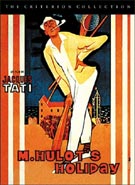
The Charge "It was the moment when I realized that comedy could be both funny and beautiful."—Terry Jones Opening Statement The slapstick comedians of today—Jim Carrey, Tom Green, and the rest—always go over the top. With no sense of restraint, they are forced each time to make each gag bigger than the last. Bigger and bigger, until they burn out. But comedy is not always about grand gestures. A truly talented comedian knows how to make the little details count. Facts of the Case They gather at the little resort village every season. The strolling middle-aged couple. The gregarious British family. The pretty blonde who looks out from her window each morning. And Monsieur Hulot, that odd, gangly man with the pipe. Here he comes, puttering up in his little soapbox derby car with its duck horn. He is quite polite, but not altogether there. Sweet and just a bit silly, Hulot is the perfect companion for a fine holiday. The Evidence In Japanese painting, there is an effect known as "negative space." Consider Hokusai's famous painting of the wave off the shore of Kanagawa. The forward motion of the wave is balanced by an almost identical curve of sky curving back upon it. The success of the painting is as much in what is absent from the painting as in what is there. The same might be said of the comedy of Jacques Tati. Take for example a throwaway gag in M. Hulot's Holiday: a child buys a pair of ice cream cones and stomps awkwardly up a flight of steps. We see the ice cream, and we expect any moment, the child will drop it. He gets to a door and cannot turn the knob. With a cone in one hand, he twists the knob slowly, as the cone dips further and further to the side. When will the ice cream fall? Now? But the ice cream never falls. The child manages to open the door, walks in, and hands one of the two cones to his sister. The joke is built around what does not happen. That is the beauty of Jacques Tati: his comedy plays along a thin edge between action and restraint. Hulot fights a rambunctious horse, but we only see him pulled back and forth from the other side of the building. The laughs come when Hulot is out of view, when we can only imagine what the horse is doing to him and when it will throw him into our view. When a heavy backpack causes Hulot to tip over and tumble out the door, we never see him fall—he flows out the door like a zephyr. We imagine the crash, but we only see him getting up in its aftermath. The joke works, but there is no pain, and no loss of empathy. Comedy always works on the loss of empathy. Pain is only funny if it happens to someone else. But we always retain our empathy for the characters in M. Hulot's Holiday, perhaps because they are universal. Tati never uses close-ups or extreme facial expressions. The seaside vacationers of St. Marc sur Mer are us. And Hulot is an everyman among them. His odd, loping walk and wide eyes (those lips always complacently pursed around his pipe) keep our attention focused on the smallest gestures. And the gags are often built on the smallest premises. In one supremely magical moment, Hulot tries to paint a boat. His paint can drifts out in the tide, only to float back in just in time for him to dip his brush. Then it drifts out again. No double takes. No rim shots. These small incidents exude charm. M. Hulot's Holiday is not a film of grandiose events: even political speeches on the radio must be drowned out by dance music, as if the film means to remind us that we are on holiday, after all. It is not a film of huge belly laughs. But there is never a dull moment, and every scene will make you smile. Criterion presents M. Hulot's Holiday in a luminous print—so clear you could swear that the summery colors peep through the black and white photography. The print is relatively free of defects and shows off Tati's postcard-like visual composition well. The mono soundtrack is crisp and well mixed. While some critics have suggested that Tati's films are like the old silent comedies of Chaplin and Keaton, it is important to note Tati's careful use of sound effects to enhance the film experience. Blowing wind, a creaking door hinge, the spare use of dialogue—all these are as carefully calculated and timed as the visual gags themselves. Criterion even includes an alternate soundtrack prepared in later years by Tati for the film's English release. While it does translate a few of the French lines (some dialogue is already in English because of the handful of British tourists in the film), this alternate track sounds a little more hollow and artificial compared to the original. A 3 1/2 minute video introduction by Monty Python's Terry Jones provides some good clues as to what to look for in a Jacques Tati film: the precise shot composition, the elegance of the gags, and the purity of the Hulot character. While a full commentary track might have been nice (maybe Jones and Tati's most recent successor, Mr. Bean creator Rowan Atkinson), the film stands well on its own, and as noted above, the silences are part of the full effect. Rounding out the extras is an odd 1936 short by a then-unknown Rene Clement (Purple Noon, Is Paris Burning?). "Soigne ton gauche" ("Watch Your Left") is a kinetic little piece in which Tati plays a farmhand suckered into the boxing ring to spar with a local champ. Of course, chaos ensues. Constant camera movement and goofy slapstick give a hint of the future Tati magic. Here Tati is more of a human cartoon than in the Hulot movies, his gangly limbs resembling an elbowless Warner Brothers character run amok. The Rebuttal Witnesses Is there a longer version of this film? The running time here is a brisk 87 minutes, but the IMDb lists the original length at 114. Of course, Tati was known for his perfectionism, and this edition of the film is based on a 1977 print. Along the way, Tati kept editing his film, paring it down over the years to its current fighting weight. Again, less is always more with Tati. It might have been nice for Criterion to include some of the trimmed footage as a bonus (assuming it still exists). But other than that, I have no complaints with the film or its presentation. Closing Statement While you may not find M. Hulot's Holiday as hysterical as a more modern comedy, you will certainly find it more memorable. Its perfect blend of sound and silence will stick with you, and leave you wanting to watch it again to fill in the gaps. Criterion has done another fine job bringing one of the great film comedians back to prominence. Hopefully, today's noisy and crass comics can learn something from the master. The Verdict The court recesses for a brief vacation with Hulot and friends. Case dismissed. Review content copyright © 2001 Mike Pinsky; Site layout and review format copyright © Share your thoughts on this review in the Jury Room
Similar Decisions: |

Printer Friendly Version |
||||||||||||||||||||||||||