|
Reviews |
Upcoming Releases |
Discussion Boards |
Staff Dossiers & Blogs |
Studio Info |
Feedback |
All Content...
Most Popular | Best Rated | By Date | Random |
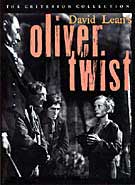
Editor's Note Our review of Oliver Twist, published September 18th, 2000, is also available. The Charge "Please sir, I want some more." Opening Statement Following a marvelous adaptation of Great Expectations, David Lean turns his attention to a much earlier, more sentimental Dickens novel, Oliver Twist. The result, which technically accomplished, lacks the strong focus that made the earlier film so successful. Stunning photography and strong performances cannot substitute for a weak central character and diffuse sense of purpose. Facts of the Case As storm clouds gather and bare branches bend in the wind, a lonely, pregnant woman struggles against the pounding rain. She arrives at the massive gate of the parish workhouse. As the storm breaks, she gives birth, and then she dies. Nine years later, her son, named Oliver Twist (John Howard Davies), is put to work. But Oliver and the other boys, fed nothing but thin gruel, envy the gluttonous warders, led by Mr. and Mrs. Bumble, and soon Oliver is roped into challenging the masters for more food. Indignant, Bumble sells Oliver to the local mortician, where the boy's grave expression makes him an excellent mourner-for-hire. But brutal conditions and the taunts of the mortician's apprentice cause a defiant Oliver to run away to London. There he will find himself drawn into the depths of the city's criminal underground. Can he keep his innocence? The Evidence Oliver Twist has always been one of Dickens' most melodramatic novels. Perhaps this is because the novel comes from early in his career, before he learned to successfully balance his crowd-pleasing sentimentality with the keen eye for social critique that marks his more accomplished, later work. Or perhaps it is the fault of the central character, Oliver himself. Oliver, like a stock melodramatic hero, is more reactive than active. He never precipitates any action in the story, but only follows the lead of everyone else. Indeed, poor Oliver is the least interesting character in his own story, carried along by the plot as the innocent pawn of others' schemes. Compare him to Pip in Great Expectations, who is necessarily reactive when confronted with the social obligations of Mrs. Havisham's world, but takes charge and acts on his own in dealing with Magwitch. This contrast gives Pip a depth that Oliver never achieves, and Pip's story is better for it. All of which leads me to wonder why David Lean chose to follow such a strong film as Great Expectations with this adaptation of Oliver Twist. Certainly, the latter book has always been a popular one, direct and accessible. And Lean's film does have plenty going for it. Lean is in full command of his visual technique here. The world of Fagin and Bill Sykes, the underworld of London, is rendered in a shadowy, expressionistic style, with striking angles and images of decay. All in all, Oliver Twist is a much darker film than its predecessor, with Oliver carried along from one horrible environment to another. The only light and straight lines come when Oliver arrives at the kindly Brownlow's house. Otherwise, this is a dark world with darker characters. Performances are fine all around. Alec Guinness, fresh from playing the young Herbert Pocket in Lean's previous film, transforms himself into a remarkably convincing Fagin. Wrinkled and decrepit, but with a false sincerity that makes him both comical and threatening, Fagin steals the film whenever he is on screen. There is a slightly disturbing undercurrent of Jewish caricature here (more evident in the novel and most other film versions—Dickens was so disturbed by the charges of anti-Semitism that he created a more sympathetic Jewish character years later in Our Mutual Friend), but Guinness succeeds in creating a distinctive character. In fact, all the villains are excellent, and the performers show great chemistry when on screen together. Robert Newton plays Bill Sykes with seedy, paranoid menace. Kay Walsh imbues Nancy with righteous defiance. And Anthony Newley gives the Artful Dodger a feral quality (much less charming than the Carol Reed musical Oliver!) that seems quite convincing for a boy raised on the dirty and dangerous streets of London. As usual, Criterion does a solid job with the transfer. While this is a darker film visually than Great Expectations, the image is still crisp and shows plenty of detail. Minor nicks and scratches mar the print, but overall, it is in great condition. The sound is also clean, essential given Lean's careful use of sound mixing. For instance, when Oliver first arrives in London, Lean suggests the scope of the crowd with cuts of running livestock and animal noises mixed with the chatter. This allows him to give a sense of London's claustrophobic bustle while still maintaining close focus on Oliver as he travels though the streets. The Rebuttal Witnesses If fault lies anywhere with this film it is in the story itself. As noted above, Oliver is too passive a character to hold the center of this tale. Our interest falls instead on the wonderful interplay between the villains. Unfortunately, this means that the film tends to grind to a halt whenever Oliver is not in peril. John Howard Davies does not help matters by playing Oliver with wide-eyed innocence through the whole picture. It is a solid and effective performance, and the fault does not lie with him at all. In fact, if anything, he plays the part too well: Oliver never seems to have an edge even when he loses his temper. He is pure sweetness and light, always aglow even when covered in grime and surrounded by danger. He makes no difficult moral decisions, and he never seems to grow as a character. But that is the way Dickens wrote him. As with Great Expectations, Criterion offers a theatrical trailer (not in the best shape) and an essay on the insert. But for some reason they seem to have abandoned the Amaray case on this release and substituted an annoying Scanavo case. Perhaps I just caught them on an off day, since this seems to be the only Criterion release I have seen so far with such cheap packaging. Closing Statement After Great Expectations, my expectations were high for David Lean's follow-up. Although Oliver Twist is (in my professional opinion as a literature professor) one of Dickens' weakest novels, I do have fond childhood memories of Carol Reed's entertaining 1968 musical (which I just watched again recently for the first time in 25 years and it holds up remarkably well). David Lean's version contains excellent performances, and is certainly worth watching to see Alec Guinness and Robert Newton in particular. But this is a film where the strengths of the performances and the director's skill sustain a story that would fall apart in lesser hands. The Verdict The court will show leniency toward Charles Dickens, with the understanding that his later work shows the maturity and balance worthy of his reputation as a great novelist. David Lean is commended for his effort, and the cast, particularly the villains, is released to prowl the streets of London once again. Review content copyright © 2000 Mike Pinsky; Site layout and review format copyright © Share your thoughts on this review in the Jury Room
Similar Decisions: |

|
||||||||||||||||||||||||||