| Home | About | Blu-ray | DVD Reviews | Upcoming DVD Releases | Contest | Podcasts | Judges | Jury Room | Contact |
|
|
|
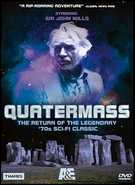
All Rise...On a sad note, while Judge Russell Engebretson was writing this review, actor Sir John Mills died at his home in Denham, west of London. He was 97. The ChargeIn the midst of anarchy, an alien force is harvesting the world's youth. Opening StatementThe script was already dated when Quatermass debuted on British television in 1979: By 2005 it is almost fodder for Mystery Science Theater 3000. The movie's events are supposed to take place near the end of the twentieth century, but the youths look like they got lost on the way to a Grateful Dead concert. This miniseries is so anachronistic I could almost detect the scent of patchouli oil clinging to the disc as I dropped it into the DVD player. What a pitiful end for the glorious Quatermass series. Facts of the CaseThe television version of Quatermass was first aired on British TV in 1979 and consists of four parts with a running time of fifty minutes apiece. Please note that the following summaries do contain spoilers. • "Ringstone Round" Meanwhile, a large group of adolescents who go by the name "planet people" make their way to a group of stone megaliths called Ringstone Round. Quatermass, Kapp, and Clare arrive at Ringstone Round to see a brilliant white light engulf the standing stones and planet people. They inspect the area and find only a white, crystalline ash covering the ground and stones. • "Lovely Lightning" • "What Lies Beneath" • "An Endangered Species" The EvidenceQuatermass is a handsomely mounted miniseries in four parts that was broadcast on British television in 1979. The storyline was originally created for Hammer Studios in the 1960s. Nigel Kneale wrote the script in 1973, and the BBC was set to film it but dropped the project after a few months, probably due to the potential cost. Euston Film took over the project in 1978 and budgeted a very generous £1.5 million for the shoot. This is the fourth and final installment in the movie series that was launched way back in 1955 with The Quatermass Xperiment, renamed The Creeping Unknown for the U.S. release. Second in the series was, appropriately enough, Quatermass 2 (U.S. title, Energy from Space, 1957). The third movie was Quatermass and the Pit (U.S. title, Five Million Years to Earth, 1967). The first three Quatermass films are remarkably good, especially given their age and low budgets, and they have a multitude of fans, of which I am one. Quatermass and the Pit is probably the best of the three, with its apocalyptic finale orchestrated by long-dead, malevolent Martians (the plot is too complicated to summarize). It was suspenseful, tightly plotted, and produced a mounting sense of dread. The first three movies are essentially horror stories within science fictional frameworks, and each one has a strong element of drama courtesy of Nigel Kneale's script. The fourth entry in the series is a letdown compared to the older movies. Even with all the money poured into special effects and outdoor locations, the miniseries fails in the areas in which the films excelled. The first episode of the 1979 Quatermass starts off swimmingly. It creates a grim, disintegrating urban landscape to great effect, and features a scathing speech that Quatermass delivers to the TV audience: He flays the U.S. and Soviet Union for wasting money on a staged space program spectacle while world governments are disintegrating. Then, halfway through the episode, the planet people appear—dancing, spinning in circles with arms aloft, and mugging amateurishly for the camera—with serapes, granny dresses, beads, and headbands on display like so much peacock plumage. One of them even carries a dowsing pendulum that he uses as a compass to home in on Ringstone Round. As soon as they pranced into the frame, my hopeful expectations for a splendid final installment began to trickle away. The dialectic of hippies (superstitious Luddites) versus scientists (rational technophiles) is tiresomely preachy, and the planet people chanting "Ley, ley, ley" every time they showed up left me longing for their disintegration in the next energy blast, just so I wouldn't have to hear that wretched chant again. Further disappointments were lurking offstage. Barbara Kellerman's acting deteriorates when she becomes hysterical, screeching and moaning like a banshee. The characters do senseless things to follow the contour of the plot (Kapp leaves his mentally decaying wife to check on a defective radio dish, though a mass murder by aliens just occurred close to their home). The story is riddled with silly science, such as energy beams that travel light years in seconds, and the electrical image of a scent crafted as bait for the unseen aliens. Worst of all is the elimination of characters whose stories are too unwieldy to resolve. There is an old technique a writer will sometimes use when he has written himself into a corner, sarcastically referred to as "and then they were all run over by a truck." It is a useful device for concluding a story or scene without actually delivering a denouement. There are numerous "run over by a truck" (ROBAT—technical acronym I just now made up) moments in Quatermass. Joe Kapp returns to his home only to find his family and coworkers ROBAT; every planet person we ever see is ROBAT (though one could credibly argue they are only alien fodder from the start); two minor characters and two major characters are ROBAT. All these deaths would be quite a downer if I could muster up some enthusiasm for the wooden characters being pushed around the game board, but Quatermass is the only role that is real enough to elicit sympathy, thanks to John Mills, the standout actor of the cast. He plays a kinder, gentler Quatermass—one who is ground down by age and personal tragedies—as opposed to the earlier, more abrasive, versions. His solid job of acting held my interest but, alas, could not make up for the story deficiencies. Because of those deficiencies, the screenwriter's distaste for hippies—more accurately, his conservative vision of sixties left-leaning youth—becomes the central motif of the script, and his obsession with hipsters and their anarchic ways creates a black hole that sucks every plot element into its gravitational field. It crushes the life out of characters and story alike, leaching suspense and viewer interest from the movie. It is a shabby and disrespectful epitaph for the tweedy old Bernard Quatermass and his adventures, which date back almost to the advent of television. The DVD extras are a bit unusual on this two-disc set. The discs are packaged in a cardboard slipcase. The first disc contains the program with no extras. The second disc contains the History Channel presentation of The Enduring Mystery of Stonehenge, a tenuous tie-in to the standing stone theme of the movie. It's passable if you enjoy this type of popularized-history program; otherwise it has nothing to do with the film. The central offering on the second disc is the theatrical version of Quatermass, which is just a pared-down version of the full miniseries. The major cut is the third installment, in which the elderly folks in their London hideout nurse Quatermass back to health. It was the weakest episode, and its removal does not adversely affect the story. The DVD transfer looks like it might have been taken from videotape rather than a 35mm print. Colors are fairly good, but uneven from scene to scene, and the picture is plagued with a massive amount of digital artifacts. The sound is adequate, though it distorts often during loud passages. The musical score is dreadful, loud and intrusive at dramatic moments (as in a soap opera), and punctuated with electronic drumbeats (think Miami Vice), corny Hammond organ riffs, and distorted analog synthesizer tones. Now that I think of it, the score does accurately reflect the tone of the movie. Closing StatementI might have judged the film less harshly if it weren't for my fond memories of the old Quatermass movies. Although I believe my criticisms are valid, the Quatermass collector will still probably want this DVD to complete his collection. However, I recommend a rental for the average science fiction fan before he forks over his hard-earned dollars. The VerdictThe film crew is free to go, but the scriptwriter is sentenced to thirty days of scraping up road kill. The composer is to be escorted to the nearest highway and ROBAT. Give us your feedback!Did we give Quatermass a fair trial? yes / no Other Reviews You Might Enjoy
• The Europeans |
|
DVD | Blu-ray | Upcoming DVD Releases | About | Staff | Jobs | Contact | Subscribe | | Privacy Policy
Review content copyright © 2005 Russell Engebretson; Site design and review layout copyright © 2015 Verdict Partners LLC. All rights reserved.