|
Reviews |
Upcoming Releases |
Discussion Boards |
Staff Dossiers & Blogs |
Studio Info |
Feedback |
All Content...
Most Popular | Best Rated | By Date | Random |
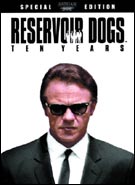
Editor's Note Our review of Reservoir Dogs, published February 14th, 2000, is also available. The Charge Four perfect killers. One perfect crime. Now all they have to fear is each other. Opening Statement It's hard to believe that it's been ten years since a nerdy video store clerk sold a great script for a film called True Romance and then turned those earnings into part of the financing for his directorial debut Reservoir Dogs. Despite the fact that Quentin Tarantino has directed only a handful of films since, he's established himself as one of the more notable directors to rise in Hollywood in the past decade. This certainly makes his upcoming film Kill Bill one of the most hotly anticipated films of 2003, especially since six years will have passed since the release of Jackie Brown. When DVD first began to rise as a home entertainment medium, several studios rushed popular titles to the marketplace, often times giving them crummy video transfers, denying anamorphic goodness (only the very rich owned HD capable equipment back then), and muffling sound just to get product on the shelves. Reservoir Dogs was no exception, and the initial treatment it received from Artisan on DVD was nothing short of criminal. Oversaturated blurry colors, cropped images, muffled dialogue, and a pittance of extra material made for a release of a film that deserved so much more. Fortunately, the 10th year anniversary of Reservoir Dogs release at Sundance is upon us, and Artisan has decided to give it another go. The old and busted gets replaced by the new hotness, but does this new DVD measure up to modern standards? Facts of the Case Reservoir Dogs begins with the unusual setting of breakfast at a diner with a bunch of hoods in cheap suits arguing over the merits of a Madonna video and the pros and cons of tipping. These guys have a much more sinister agenda, however, as the plan is to knock off a jewelry store and get away with $2 million in diamonds. For this job, Joe Cabot (Lawrence Tierney, Dillinger) and his son Nice Guy Eddie (Chris Penn, True Romance, Pale Rider) have assembled a wretched crew of scum and villainy: Mr. Blue (Eddie Bunker, The Long Riders) Mr. Brown (Quentin Tarantino, Pulp
Fiction) Mr. Orange (Tim Roth, Planet Of The
Apes, Rob Roy) Mr. Pink (Steve Buscemi, Fargo, Things
To Do In Denver When You're Dead) Mr. Blonde (Michael Madsen, Species, Donnie Brasco) Mr. White (Harvey Keitel, From Dusk Till
Dawn, Cop Land) Of course, the job goes wrong and Mr. Orange receives a belly wound that needs medical attention. As the band of surviving thieves begins to gather at their meeting place (an abandoned warehouse for a mortuary), they begin to piece together the events that led up to a squadron of police officers descending upon the jewelry store and figure that one person on the job was an undercover cop. Mistrust is bred as we see a series of flashbacks that will lead to the identity of the police officer and to a harrowing ending that will leave several characters questioning their own sense of morals. The Evidence Quentin Tarantino may have been ready for the Sundance Film Festival, but I seriously doubt the Sundance Film Festival was ready for Quentin Tarantino. Reservoir Dogs presented stark, gritty, realistic violence and coupled it with crass, vulgar language and dark humor, something that had never really been presented in such a way before. This was a general wake-up call to the crowd, but then, keep in mind that Tarantino also managed to present a sensible story with a moving ending (involving plenty of bullets) paired with Tarantino's own unique style of culture-referencing dialogue. If there's any downside to Reservoir Dogs, it's that this film has inspired way too many crummy copycats. Tarantino was also the director who made non-sequential storytelling hip and cool again (or, who knows, maybe for the first time) with his frequent flashbacks, some of which were further imbedded into other flashbacks. While Tarantino refuses to call them flashbacks (in Reservoir Dogs, technically, they are flashbacks, though they are not considered to be in his follow-up Pulp Fiction), they allow us to get better glimpses of all of the characters with the exception of Mr. Pink. But what else does Reservoir Dogs really have to offer? Well, it's a bit of a conundrum of a film. At its heart, it's a cops and robbers movie that focuses on the robbers. The cop in this case is the "bad guy" since he's violating the level of trust and the honor amongst thieves that exists in this narrative. Next to that, Reservoir Dogs is a heist film where we don't actually get to see the heist. We see a couple of glimpses of the aftermath, including Mr. Pink shooting his way out with the diamonds, but nothing more. This leaves the audience to piece together what exactly happens, taking into account the different stories offered up by the various characters. Even the accounts of Mr. Pink and Mr. White (the two "grab men") vary enough to make the audience doubt the sequence of events. Reservoir Dogs is a violent movie where a surprising tiny amount of actual violence is depicted on screen. Even the horror of the now infamous "ear" scene is shown off screen, something that I contend gave it a more nauseating and deeper effect on the audience. Some people even hold up Reservoir Dogs as an action movie, which is a mistake on their part since it's the wordplay that stars in a very dialogue-driven film. Many people cite Tarantino's later works, notably Pulp Fiction, as the best in his oeuvre, but for some reason Reservoir Dogs has remained as my personal favorite. There's a level of raw energy that Tarantino brought to the film, levels that he gets close to in his other efforts but never tops. Pulp Fiction is more stylish and polished, while Jackie Brown is the work of a more mature director, Reservoir Dogs taps into an unbridled enthusiasm. The themes of Reservoir Dogs also seemed to resonate a bit more deeply with me. The ideas of honor, trust, betrayal, and loyalty all come into focus as the film's endgame plays itself out and turns Reservoir Dogs into something of a morality play. It had been several years since I'd seen this film, and I'd truly forgotten just how powerful the ending truly is. Tarantino's rookie effort deserves the accolades that it's received in the past, and it certainly deserves the accolades I'm giving it now. If you haven't seen it but you're a fan of Tarantino's later work, I can only urge you to see Reservoir Dogs. Of course, Tarantino's life was made much easier when he managed to collect and sign an incredible cast. As much as I think about it, I cannot imagine any other actors portraying their assigned roles. Keep in mind that a few of these performances were breakout roles. The odd-looking, squirrelly Steve Buscemi has gone on to become a preferred actor in independent projects, and Michael Madsen (a veteran That Guy by this point) proved that he could step into the shoes of a major Hollywood Heavy. The absolutely crucial performances come from Harvey Keitel as Mr. White, whose sense of honor and loyalty will be shaken and put to the test, and Tim Roth as the condemned Mr. Orange, who actually spends most of the film bleeding to death from a bullet in the gut. (It's a good thing they set him on a ramp so the blood could form a giant pool at the bottom.) There's a bond that forms between White and Orange that becomes crucial to the story, and it's the skill of both actors that makes it work. You almost believe they actually shot Tim Roth in the stomach during a few scenes. Artisan has managed to load Reservoir Dogs with a ton of terrific special features. For starters, they've provided an audio commentary for the entire length of the feature. While this commentary track contains a great amount of quality information and stories from the cast and crew, I should point out that this is a commentary that's spliced together from various interviews and such. I was hoping for a commentary track similar to the View Askew films where the participants all gather and tell stories about the film, or maybe multiple tracks featuring cast on one and then crew on the other to talk about technical details. Unfortunately, this didn't happen. As it stands, this is still 100 minutes pretty well spent if you enjoy the film. Another bit of disappointment is the curious absence of Steve Buscemi. On the plus side, they made sure to include Kirk Baltz, who portrayed the hapless Officer Nash. Where the commentary disappoints ever so slightly, Artisan manages to make up for it in the form of six brand new interviews with Tim Roth, Quentin Tarantino, Lawrence Bender, Chris Penn, Kirk Baltz, and Michael Madsen. I'll point out that the various interviews are just as quirky and bizarre as something you'd expect in a Tarantino flick and I'll leave it at that. Between two of the interviews, there's a pretty interesting story about Kirk Baltz and the trunk of Michael Madsen's car (the car was a prop in the film). I'll leave you to discover the fun and discern who was telling the truth about the incident. Various parts of these interviews (and a few others) are then spliced together for "A Tribute to Lawrence Tierney," who apparently tried to start a fistfight with just about everybody on the set. There's also a "Tribute to Eddie Bunker," a guy who did time in real life for performing heists, that consists of Eddie and a cameraman driving around and Eddie talking about his life of crime. He also talks about getting his ass kicked by Lawrence Tierney on a weekend night back during the '50s. (Bunker admits he didn't remind Tierney of the incident when they officially met on the set.) Artisan then follows with a number of deleted scenes. As usual, these tend to be kind of cool and manage to add a bit of depth to the characters, but you can pretty much see why they were deleted. One in particular delves further into Mr. White's spotty past and helps explain some of White's actions. These deleted scenes also include two alternate angles of the infamous ear scene, one of which is an extreme and very fake-looking close up. After seeing these scenes you will completely understand why the ear scene was edited the way it ended up. "The Class of Sundance '92" takes a retrospective look at how the indie film scene exploded that year, giving film audiences a true alternative to the Hollywood schlock machine. This segment consists of interviews with directors who premiered films at Sundance '92, including Alex Rockwell (In the Soup), Chris Munch (The Hours and Times), Katt Shae (Poison Ivy), Tom Kalin (Swoon), and Tarantino himself. Definitely interesting stuff as only one of these directors seems to have made it really big. Bonus points for Rockwell's "Who Shot Nice Guy Eddie?" T-shirt. The Sundance section also includes "Tarantino's Sundance Institute Directors Workshop Lab," where a number of scenes are rehearsed and acted out about one year before the release of the film. These include Steve Buscemi doing his turn as Mr. White. Along with the tributes mentioned above, there's another set of tributes featuring interviews with some of the directors and actors (including Jackie Brown's Pam Grier) who influenced Tarantino in some way. This theme is given more depth in the "Film Noir Web" feature, which is a text-only look at Film Noir as a whole and the influences felt in Reservoir Dogs. This includes various Hong Kong crime thrillers such as Ringo Lam's City On Fire (a story about a cop infiltrating a ring of jewel thieves. Hmmm…) and some of the works of John Woo and Don Siegel. (Actually, this list is far too lengthy to reproduce, but it is an excellent reference for other genre films.) The one thing I can at least admire about Tarantino is that he isn't shy to admit that these other films heavily influenced his work. Most other directors borrow bits and turn them into something new, but Tarantino flaunts it. I like it. There's a special commentary section where three film critics dissect about 30 minutes of select scenes of Reservoir Dogs. Included in this little exercise is Peter Travers (Rolling Stone), Amy Taubin (Film Comment) and Emanuel Levy ("Cinema of Outsiders: The Rise of American Independent Film"—a book I may have to check out after listening to him). All three of these folks do a pretty good job of explaining Tarantino's mystique and successfully arguing that Tarantino's career will certainly be significant in the history of film. The last of the really lengthy extra features is the K-BILLY Interactive Radio program. This features a few different, scattered interviews, starting with "Mr. Big," a guy in a federal prison for pulling jewel heists. Also included is an interview with Gerry Rafferty, the lead singer of Stealer's Wheel. Gerry was a co-writer of the song "Stuck In the Middle With You," which I'll point out you'll never think of in any normal fashion again after watching Reservoir Dogs for the first time. (Tarantino had this same effect on The Revels' song "Commanche" in Pulp Fiction thanks to a nasty sodomy scene.) This section finishes out with the outtakes of Steven Wright recording his K-BILLY dialogue. Spiffy! The special features are rounded out nicely with "Small Dogs," a look at the development of the action figure line, and "Securing the Shot," a short look at the location scouting done for Reservoir Dogs. Artisan then ends it all with a "Reservoir Dogs Style Guide," followed by the obligatory theatrical trailer and a poster gallery. All told, this is about as complete a package as you will see anywhere on any DVD. The Rebuttal Witnesses Before I move on to the DVD specifications, I'll point out that Reservoir Dogs is one of those movies in the "love it or hate it" category. It's a polarizing film that divides audiences with the gruesome, realistic violence and the frequent foul, vulgar language that Tarantino uses to shock his audiences. Never mind that these elements are frequently used to provoke laughter (some times right after a moment of utter disgust). In fact, one of our own judges (who shall remain nameless) admitted to not watching further than Officer Nash's torture scene. This film is definitely not for everybody, and it's certainly not for the squeamish. There is also another portion of the population who just didn't "get" the ending, and Tarantino has some choice words for that crowd during the commentary track. While the violence in Reservoir Dogs has managed to cause a special level of controversy, Artisan has managed to cause even more with the transfer quality of this 10th Anniversary Edition. I typically don't put a great deal of research into these reviews when I start looking at the technical merits of a DVD, typically reacting with instinct and with what I notice on the way through. I should point out that several other DVD review sites posted reviews of Reservoir Dogs before this one was finished, and several of them have really taken Artisan to task for a transfer that's actually worse than that on the DVD Artisan produced a few years ago. I found this rather odd since the transfer was oversaturated with red (most of the characters looked like they had sunburns), and had issues with edge enhancement and compression artifacts throughout. On top of that, the low end of the audio spectrum left dialogue as a muffled, garbled mess. Now, is this new video transfer better? I'm going to go out on a limb and say yes. Is it a good transfer? Decidedly the answer is no. Where Artisan went far too heavy on the red with the early transfer, this time they backed off on the color spectrum as a whole and gave parts of this DVD a bleached-out look. Is it as bad as some of these other web sites have made it out to be? Again, the answer is no. The opening sequence that has the Dogs walking down the street in their cheap black suits while the credits roll has been set up as a harsh example of the very worst of this transfer, and there may be some merit to that. It's frequently been pointed out that their suits don't look black enough, and again there is some merit to that statement, as well. But if the transfer is as bleached out as some of these people have made it out to be, why then are there perfectly dark, black shadows seen later on in the film while the suits still appear to be a very dark black/gray color? Why then does Mr. Orange's blood still appear to be the bright red it's meant to be? Please don't get me wrong—the colors on this transfer are not perfect, but keep in mind that this film was shot on a low quality film stock and poor equipment. This could explain a great deal of the color degradation seen throughout, or it could be that Artisan simply mucked it up. Either way, nobody seems to be talking. If the color fading was the only problem this transfer of Reservoir Dogs had, I wouldn't be all that upset. Unfortunately, a few other problems manage to manifest themselves throughout the film. Most notably there are issues with edge enhancement, especially when characters are standing in the background. There are also some problems with pixelation, which is most noticeable on the warning tape of the ramp that Mr. Orange is slumped upon in the warehouse. While I'm not going to be as hard on the color issues as some of the more vocal critics have been, all of these problems combined add up to an average (at best) effort from Artisan. This was their chance to give fans the absolute best edition of Reservoir Dogs, and now we may very well have to wait for another ten years. This transfer has caused a DVD that could easily have won several "DVD of the Year" Awards and trod all over those hopes (though it may get some "Honorable Mentions" on the merits of the special features alone). Another issue has been raised in the framing of this version of Reservoir Dogs, with numerous people also pointing out that this version is incorrect. In one of the interviews Tarantino mentions that Reservoir Dogs was originally shot in Scope and it was matted down. What this DVD provides is the true, original aspect ratio of Reservoir Dogs, something that hasn't been seen by too many people until this point in time. The audio mix is excellent, especially for a low budget film. The 5.1 mix is pretty underused due to the film being mostly one conversation after another, but it does kick in with atmospheric noise at the proper times, and helps the film's unique soundtrack of '70s music (another point of Tarantino's style) leap to life. There's also a DTS track included on this DVD, and while I couldn't sample it, I can't see that it would be too huge of an improvement in this case. Closing Statement While Reservoir Dogs isn't a movie suited to everyone's taste, it stands up as one of the greatest directorial debuts in film history. If you're a Tarantino fan, get this DVD. If you like gangster flicks, get this DVD. If you like great dialogue and an intriguing story, get this DVD. Note, however, that if you have any concerns that the quality of the transfer may end up disturbing you and causing you to riot in the streets, I might first suggest renting the 10th Anniversary Edition of Reservoir Dogs. The Verdict The cast and crew of Reservoir Dogs are free to go. As far as Artisan and this below standard transfer, all I have to say is that I am a hanging judge. You can infer what you wish from that statement. Review content copyright © 2002 Kevin Lee; Site layout and review format copyright © Share your thoughts on this review in the Jury Room
Similar Decisions: |

Printer Friendly Version |
||||||||||||||||||||||||||||