|
Reviews |
Upcoming Releases |
Discussion Boards |
Staff Dossiers & Blogs |
Studio Info |
Feedback |
All Content...
Most Popular | Best Rated | By Date | Random |
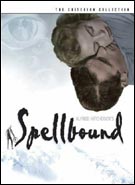
Editor's Note Our review of Spellbound, published February 18th, 2004, is also available. The Charge "Oh, you're not his mama. You're an analyst."—Brulov (Michael Chekhov) to Constance (Ingrid Bergman) Opening Statement At Green Manors, Dr. Constance Petersen (Ingrid Bergman), wrapped in frigid white, forces a hysterical woman who manipulates men to recognize the "bad" feelings inside her. Constance, a "brilliant but lifeless" doctor, according to one colleague, is frozen in place as both a doctor and a woman. When the new head of Green Manors, Dr. Anthony Edwardes (Gregory Peck) arrives, Constance immediately finds him handsome and charismatic, but she is also unnerved by his obviously neurotic symptoms, especially his panic over parallel lines and the color white. Nevertheless, she responds as a woman when he moves forward to kiss her. All the doors of the mind swing open—and the dream begins… The Evidence I keep having this dream. In it, Ingrid Bergman and Gregory Peck are at a ski resort, hurtling down a slope with flawless coiffure and not a speck of snow on them. Suddenly, Peck realizes that his deepest problem stems from having killed his own brother—and he immediately remembers his entire lost identity. No guilt, no doubt. He is in love, innocent of all crimes, and ready to face the world. And then it occurs to me that this is not a dream at all, but Alfred Hitchcock's Spellbound. Bergman and Peck are indeed skiing, and as I play the scene again, I cannot overcome the troubling sense that all is not well. Maybe I am projecting my own unease, my own sense that there must be something here to interpret. After all, people do not go skiing and not get mussed in real life. But maybe they do in Hollywood movies, especially movies produced by David O. Selznick, who was notorious for his perfectionism. Am I supposed to take this scene at face value, or is Hitchcock playing a game with me? I know David Selznick is not playing. Romance is serious business to him, and women need to understand their role in the process. Dr. Constance Petersen (Ingrid Bergman) is constantly reminded of her feminine side, in particular her role as lover and protector of men. From the moment she falls in love with the mysterious J.B. (Gregory Peck), whose masquerade as Dr. Edwardes is quickly revealed, her dedication to science directs her toward romance. Indeed, mental illness and romance longing—both collapsed into hysteria—become equivalent: when J.B. asks "Will you love me this much when I'm normal," Constance can only respond, "Oh, I'll be insane about you!" Is Constance a doctor or a woman first? But maybe the question is not really about who Constance is, but whom J.B. thinks she is. From the moment J.B. and Constance first move together to kiss, and Hitchcock dissolves to a hall of opening doors, we enter a surreal world that might be only safely explored as a dream. Scenes play out in full tilt melodrama: J.B. panics in a surgical ward, then declares his love for Constance and flees the hospital. But, as Lesley Brill points out, the thick artifice of Spellbound may be part of Hitchcock's game. Freud's notion of psychoanalysis itself is a romantic myth, as artificial an attempt at closure as the Hollywood romance. Perhaps in this sense, Spellbound is Hitchcock's assault on the mythmaking of David Selznick, whose romantic fantasies (like Gone With the Wind) routinely repress past traumas. How else to explain the sequence where Constance goes to the Empire State Hotel, where a succession of men flirt with her, including the house dick? When he casually says, "I'm a married man myself, and I know how it feels to have a wife come chasing after you to apologize," we realize that this is a man's dream of doting femininity. Constance as doctor really must become J.B.'s mother, curing him and protecting him and preparing him for their Oedipal relationship: "I'm going to do what I want to do: take care of you and cure you and remain with you until that happens." Psychoanalysis becomes the nurturing gesture of a protective mother. Suddenly, the romantic couple, J.B. and Constance, find themselves buying train tickets from a bald man behind a barred window. Are the Freudians in 1945 nodding in agreement? They would certainly agree with Dr. Brulov (Michael Chekhov), Constance's mentor, who calls her a "schoolgirl" and makes it clear that "women make the best psychoanalysts, until they fall in love. Then they make the best patients." He is ever the Freudian and supporter of heterosexual monogamy (like a proper Hollywood film doctor), announcing that "there is nothing so nice as a new marriage. No psychosis yet, no regressions, no guilt complexes." The Hollywood marriage erases all trauma and lets us live happily ever after, letting us "have babies and not phobias." But the journey toward such fulfillment is a rough one. Two cops sit in a waiting room, and one chats about being a "mama's boy." When Brulov wants to cool off the hysterical J.B. (who comes at him with a razor), he offers the man a glass of drugged milk. Mother is necessary, but she is also dangerous and must be transcended in order to be healthy. As cultural critic Slavoj Zizek is fond of pointing out, Hitchcock films are all about the maternal superego. And in Spellbound, the superego, both mother and father, must be overcome, even by violence, in order to achieve romantic closure. Yet, there is a sense in which Spellbound can never overcome its parentage. Criterion labels the film "Alfred Hitchcock's Spellbound," as if one father claims all rights. However, Spellbound's credits announce that its real parent is David O. Selznick. While some of the Hitchcock touches are there, especially a masterful use of lighting, silvery to surround Constance or filled with shadows and lines where danger lurks, the most notorious sequence in the film is not Hitchcock's at all. J.B.'s famous dream sequence (in which he tells Constance and Brulov about the murder reimagined as a visit to a casino) was imported into the film by Salvador Dali. Unfortunately, the scene itself, meant to be the key to unlocking J.B.'s secrets, appears abruptly in the film and feels tacked on, a "greatest hits" collection of images which is explained in too straightforward a manner. But in lieu of the failed "Destino" project with Disney, this was the closest Dali got to Hollywood. Oddly, it does not seem to matter, because in a movie that itself unfolds like a dream, there are far more interesting surreal touches (like the skiing sequence) in the film that Hitchcock can take credit for. Maybe there is something significant about this feeling that the Dali sequence does not fit. This is a film about psychoanalysis, a process by which everything is directed to fit together to form a consistent picture of the psyche. Hitchcock uses psychoanalysis in so many films (Psycho, Marnie, Vertigo) that it has become a familiar motif. But he almost never treats it at face value, preferring to allow interpretive openings into this method of interpretation. Only in Spellbound, made with the cooperation of a "psychiatric advisor" (one Dr. May E. Romm, who seemed to miss the gender politics behind Freud's theories, as I suppose did most in her profession in 1945), does psychoanalysis get taken altogether seriously and without question. Or so it would seem. Which is exactly why I suspect that we are to take Spellbound as a dream, a fantasy about the efficacy of psychiatry and the redemption of romance that plays out in J.B.'s head. Of course, that could only be a fantasy of mine, an attempt to make sense of what is, after all, a Hollywood movie that appears to conform to the rules of the imperious Selznick. In any case, I am still left flipping through my notes (and you should see all the analysis, and psychoanalysis, that I have left out of this argument) trying to make sense of this patient, chalking up all the inconsistencies and surreal touches to some master plan of Hitchcock to make fun of Selznick and Freud. I am ultimately uncertain, ambivalent, about my own interpretation, in a film that insists (at least casually) that interpretations need to be decisive, like lovers running off together without thought of the consequences. I do not have quite the certainty of Criterion, which has no qualms about declaring this film a masterpiece and packing it full of the sort of extras that makes it the best place to get films of artistic relevance. The black and white print shines with haloes of light (tough to master without making everything blurry) and even includes the important subliminal red flash at the film's climax (the sign that we are waking up from the dream). The monaural soundtrack has been remastered to include the rare overture and exit cues. As always, Criterion does a hell of a job with the presentation, even down to the analytical essays in the insert. The commentary track by Marian Keane embraces Freud, although Keane too seems rather ambivalent about Hitchcock's film, as Hitch's film is ambivalent about psychoanalysis—and perhaps interpretation itself. For those who have heard Keane's commentaries before, this is all familiar: psychoanalytic criticism with an "authorship" (auteur) theme. But in this case, the interpretation seems troubled by the presence of two fathers: Hitchcock and Selznick. Highly detailed and intelligent, Keane's comments are probably of more value to film scholars than to the average watcher. But strangely, there is too much straightforward plot explication here, as if Keane is going through the motions more than usual. Overall, this track is weaker than expected only because Spellbound itself is far from Hitch's best, giving Keane less to work with than, say, on Notorious. Criterion coyly dubs the supplemental section a "Labyrinth," although the extras are quite solidly organized. First, a collection of production correspondence (Selznick was famous for his memos) includes a summary of Francis Beeding's 1927 novel The House of Dr. Edwardes by a studio assistant. The novel, a "psychological horror melodrama" bears little resemblance to the movie and sounds like the worst sort of gothic drivel, with doctors instead of debauched noblemen and plenty of satanic rituals and spooky happenings. A series of story treatments by Angus McPhail and Ben Hecht follow, in which the authors try to make sense of Beeding's book by throwing most of it out. Then the psychoanalysts leapt into the fray, with an exchange of letters offering technical advice to Selznick. After this, the Breen Office took a heavy hand to the film, trying to snip any reference to "the flavor of sex," even though you cannot get very far in a Freudian narrative without it. Finally, we are treated to some post-screening feedback sent to Selznick. Regarding the film's visuals, Criterion includes an extensive stills gallery (including some of the radio cast) and an illustrated essay by James Bigwood on Dali's work for the film. No detail seems to be left out of this overview, including the bizarre "ballroom sequence" cut from the film, in which Constance turns into a statue and pianos hang from the ceiling. Bigwood also notes that the famous final version of the dream sequence was put together by William Cameron Menzies, who declined screen credit, and not Hitchcock. Indeed, most of the backstory on the production included in the various supplements seems to downplay Hitchcock's contributions to this film, which explains why he (and many Hitchcock experts) did not look kindly on Spellbound in later years. Joseph Cotten (Hitch's original choice for the male lead) and Alida Valli star in the 1948 radio adaptation of the film, which eschews most of the visual details, obviously, leading to a more melodramatic surface plot. And oddest of all, there is a collection of supplements devoted entirely to the Theremin, ranging from a 28-minute interview with Miklos Rozsa (apparently just audio notes, since it is all very hissy) in which Rozsa says almost nothing about Spellbound, except that he hated Selznick. There is also a 7-minute NPR segment on the Theremin and a bibliography. I've played with a Theremin and quite enjoyed it, but I am not sure what all this stuff is doing on the disc. Closing Statement Maybe the supplements hide a sense of desperation regarding Spellbound. It is a Hitchcock movie, yes. It has a great cast and crew and an impressive pedigree. But there is something ultimately alienating about the film, as if we cannot be sure whether or not we should take it seriously. If this film's approach to psychoanalysis is indeed, as Marian Keene remarks, "closed to interpretation," then what in the end shall we do with it? How do we treat a patient that refuses to speak with candor? That is the most frustrating thing about Spellbound: it stubbornly guards its secrets—assuming it has any secrets to guard. As Hollywood filmmaking, especially that of David Selznick, goes, its opacity is its greatest virtue, since it suggests depths that other mainstream Hollywood films feared to explore. But in the canon of Alfred Hitchcock, it suffers in comparison to the films that will speak, like Vertigo and Notorious, even if they usually speak in riddles. Criterion has done a hell of a job here, as usual, but it is not their fault if Spellbound refuses to cooperate with us. Some patients just do not want to be cured. The Verdict This court withholds judgment until the patient, um, defendant is more forthcoming with his secrets. In the meantime, Alfred Hitchcock and Criterion are released for their admirable attempts at treatment. Court is adjourned. Review content copyright © 2002 Mike Pinsky; Site layout and review format copyright © Share your thoughts on this review in the Jury Room
Similar Decisions: |

Printer Friendly Version |
||||||||||||||||||||||||||