|
Reviews |
Upcoming Releases |
Discussion Boards |
Staff Dossiers & Blogs |
Studio Info |
Feedback |
All Content...
Most Popular | Best Rated | By Date | Random |
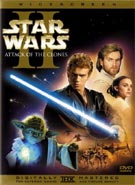
The Court finds the following facts to be in evidence: Our story concerns the continuing growth and development of Anakin Skywalker (Hayden Christensen) on the road to becoming the greatest screen villain of all time. Along the way he falls in love with Padmé Amidala, Senator from Naboo and future mother of their twin children. Together they witness the beginnings of the legendary Clone Wars, which as we all know will bring about the fall of the Republic and the rise of the Empire. The Court held, with regard to the Attack of the Clones DVD Release: [Editor's Note: The following paragraph was edited after the review's initial publication to correct some of the technical details regarding the digital filmmaking process. Our thanks to alert reader—and filmmaker—Vincent Pereira for his assistance.] Much has been made of the all-digital filming technique that George Lucas employed in making this movie. By using all-digital source material he was able to composite all-digital effects elements and create some of the most seamless special effects shots ever seen. More importantly for our purposes, the all-digital source material transfers to DVD clean as a whistle. The picture quality is amazing, with every scene looking crisp and lifelike. Color fidelity is dead on, including the trickiest reds, blacks, and flesh tones for a wide variety of human and alien characters. Every detail is sharp and clear, from every wrinkle in Yoda's skin to every hair on Natalie Portman's head. There are some scenes that show quite a bit of picture grain. Well, that is not totally accurate; given the all-digital nature of the filming, these are digital video imperfections or "noise," not film grain in the strictest sense. The result to the viewer is the same, however, and these scenes do look "grainy," for lack of a better descriptive term. This was especially pronounced in darker scenes, such as the assassination attempt on Padmé in her bedroom in chapter 6. Shadows and dark areas in most scenes showed excellent definition, but this scene was murkier than I would have expected. The rest of the movie looks amazing, with a real sense of depth and three-dimensionality that can only come from the best transfers. There are a few notable glitches; it appears to me that there is some occasional edge enhancement and associated haloing, although it is not nearly as pronounced as it was in the Phantom Menace transfer. There is also some minor shimmering at the edge of Anakin's blanket in the "nightmare" scene in Chapter 25. However, it must be stressed that these complaints are minor quibbles, and that overall the quality of this disc is nothing short of spectacular, and one of the best transfers I have seen to date. The audio comes in loud and clear in an amazing Dolby Digital 5.1 Surround EX track. The Star Wars films are known for their incredibly complex sound environment, and this track delivers every element perfectly. Everything from the opening score to directional starship flybys to Jango Fett's seismic mines will leave all but the most jaded viewer breathless. This is an audio mix that will not only show off your sound system; it will show you its shortcomings. Also included are Spanish and French language tracks in Dolby Digital 2.0 Surround. These tracks were quite impressive as well, and sounded completely natural. The Spanish language track, which I sampled, sounds as good as the English language tracks on some major studio releases. (As an added bonus, Jar-Jar Binks is much more tolerable in Spanish than he is in English.) The DVD of The Phantom Menace was hailed as one of the best DVDs that had been released up to that point. Attack of the Clones, with over six hours of special features, beats it. (And in this case, the movie is worth watching too!) It's almost too much Star Wars goodness to believe, spread across two discs. On disc one there is the feature presentation, as well as the excellent commentary track. It's a group effort, featuring input from George Lucas himself, producer Rick McCallum, sound designer/film editor Ben Burtt, ILM animation director Rob Coleman, and ILM visual effects supervisors Pablo Helman, John Knoll, and Ben Snow. Lucas, McCallum, and Burtt appear to have recorded their thoughts in solo sessions, while the quartet from ILM were recorded in a group session. The comments from all of the contributors are edited together fairly seamlessly. It's a nice blend of perspectives on the film, from Lucas with his ideas on the story and mythology that he has created, to McCallum and his observations on actually getting the movie made, to the insights of Ben Burtt (who should probably be making his own movies) and on down to the wisecracks and technical insights of the ILM crew. This is a first-rate commentary track, entertaining and informative. The collection of extra material on disc two totals almost four hours, and covers almost every aspect of the production of Attack of the Clones. Here's a quick list of what is in store: • Trailers and TV Spots. This section includes three
teaser trailers and the full-blown theatrical trailer, as well as twelve
different thirty-second TV spots. Also included is the "Across the
Stars" music video. This video mixes scenes and dialogue from the film
with behind-the-scenes footage of John Williams crafting the score and
conducting the orchestra. It's interesting but cheesy; I would rather have seen
a documentary featurette dealing with Williams's contributions to the movie. It is a massive collection of information that is sure to please any Star Wars fan. In a larger sense, this is good information for anyone wanting to know more about how films are made these days, and how technology has changed the movie making process. As a final, minor bit of praise, I would like to note that Attack of the Clones is divided into fifty—count 'em fifty—chapter stops. This means that viewers will be able to find whatever scene they want with extreme precision. It is little user-friendly touches like this that make this DVD so great. There were a few frustrating things about this DVD. First and foremost, there is the problem of the exclusive online content. This content requires the InterActual Player to access, which the DVD will only too happily install. The problem is that, much like the Phantom Menace DVD, I have yet to find a machine on which these additional features will actually work. Another quibble with the DVD is the animated/sound/motion menu system. I admit to being something of a curmudgeon when it comes to DVD menus; I firmly believe less is more. The people at Fox and Lucasfilm clearly believe that more is indeed more. The menus provided on the disc are very impressive and immersive, but to me they take up too much time and generally slow down the process of finding what one wants to find. To each his own, I guess. One last comment concerning Rick McCallum, producer and (apparently) The Flanneled One's right-hand man: I've obviously never met the guy, but he manages to come across as completely arrogant and smug at all times, whether in various documentary clips or in the commentary track. He's probably a perfectly nice person in real life, but he unfortunately projects the stereotypical image of a movie industry executive, extremely self-satisfied and cocky. In conclusion, this DVD is nothing short of breathtaking. The only things that could possibly have improved it would have been a DTS audio track (yes, I know the issues with this, dream on) and a few more "play all" options in the special features submenus. It also would have been nice to actually be able to access the "special internet features," but given the wealth of supplemental info on these discs, I'll let it slide. Individual members of the Court held, with regard to the film itself: Judge Erick Harper: Concurring Opinion I'll spare you the usual pontifications about the importance of Star Wars as a cultural icon. I'll spare you the self-important platitudes about the significance of Star Wars to all of us born between about 1960 and 1980. The reason for this is simple; unless you've been living in a cave for the past 25 years, you already know these things. The basic question before the Court: is Star Wars Episode II: Attack of the Clones better than the previous fairly dreadful installment? The answer is most certainly yes. Does it live up to the heritage of the Holy Trilogy? Again, the answer is yes, with some reservations. The excitement and adventure are back, and this film, unlike The Phantom Menace, truly feels like a Star Wars film from start to finish. However, it is not without its flaws. I will limit my discussion to three main areas of disappointment. 1. The Romance. The romantic elements in AOTC have been unfairly ridiculed. The movie did not need fewer of these scenes; it needed more of them if the relationship was to be deeper and more believable. The deleted scenes on the DVD bear this out; the film would be much better had they been included. We could easily have lost some of the existing scenes: two teenagers in a meadow talking about politics is not believable or romantic. 2. Personal Focus. Lucas presents some incredible visuals in this film, especially the Execution Arena/Clone War sequences. He unfortunately forgot to give our characters anything meaningful to do during the excitement. Compare the Clone War battle to the battle from The Empire Strikes Back. Empire's great action setpiece took the action to a personal level in the cockpits of Luke's and Wedge's snowspeeders, while keeping an eye on Han and Leia. In contrast, one could easily fast-forward through the Clone War action scenes and miss nothing in terms of the story. It is breathtaking but lacks personal focus; a character like Mace Windu could have been put to much better use in these scenes. As bad as Jake Lloyd's Anakin was, he at least provided a focal point during the The Phantom Menace's final battle, much the way Luke did for us in 1977. 3. The Duel. Lucas and McCallum mention in the commentary track that they were afraid the final lightsaber sequence would be totally ridiculous. Their fears were justified. Yoda bounces around like a SuperBall, swinging his sword wildly and with no relation to anything his foe is doing. The mystique of the great Jedi master has been destroyed. Despite these criticisms (and many more for which time fails) I remain one of the Star Wars faithful as I have been since 1977. From this perspective I say that Attack of the Clones, in spite of its flaws, restored my faith in George Lucas as a storyteller, if not as a filmmaker. This is an excellent DVD of a pretty good but definitely flawed movie. It's nice to see the Holy Franchise finding its way again. Judge Rob Lineberger: Concurring Opinion He is more machine now than man…twisted and evil! My esteemed fellow Judge Harper has admirably covered the commendable technical merits of the DVD and critiqued the movie itself. My meta-opinion regards disillusionment giving way to hope. With the release of The Phantom Menace, it was as though millions of voices cried out in anticipation, but were suddenly silenced. In one fell swoop, Lucas introduced disillusionment, CGI, and Jar Jar Binks into the Star Wars Universe. It is impossible to discuss Star Wars Episode II: Attack of the Clones, independently of the emotional baggage from Episode I. When Lucas released the special edition Star Wars in theaters, I stood in line for hours with hundreds of other die hard fans. The time flew as we joked and caroused in the parking lot waiting for tickets. That night we sat in awed, entranced silence. The strains of music played, the words came up, and we cheered as one. The hairs on the back of my neck stood up. Some people cried, most just had a look of enraptured excitement on their screenlit faces. We laughed at jokes we had forgotten were funny after literally hundreds of viewings of the first film. It was perfect. Then changes flickered across the screen. Murmurs were heard. Disquiet fell. When all of a sudden there arose such a clatter, I sprang from my seat to see what was the matter! There, in the cantina at Mos Eisley Space Port, Greedo shot at Han and missed from point blank range. That was the turning point, a trend that was magnified in Episode I and has been well-chronicled. Let's just say The Phantom Menace was disappointing in many ways. With my hopes dashed on the rocks, I saw Attack of the Clones in the theater. Despite my jaded cynicism, something happened. A long dead part of me stirred, like Jack's magic bean taking root in the earth. I couldn't get over the atrocious dialogue, but running around on screen were Obi-Wan, Boba Fett, Palpatine, and Darth Vader. Could this be the Star Wars I loved as a kid? I hadn't planned to buy the DVD, but what the hell, it was ten bucks. Ten bucks to rescue my wounded inner child. After viewing the DVD, I have faith that the series will resolve itself. Some of the action scenes in Episode II are fantastic. (Ironically, the lightsaber battles are not as good as the scenes with Darth Maul.) When Obi-Wan takes on Jango Fett, and when Anakin seeks out his mother, and when the two Jedi hunt down a would-be killer, it feels right. The chase through the asteroid field is amazing. Yoda teasing Obi-Wan about losing a planet seems like the old Yoda. There is something here to hold on to. Yet the most promise takes the shadowy form of Count Dooku. Here we have an enigma. He wields a red lightsaber, and clearly has dealt one-on-one with the Sith. He holds Obi-Wan prisoner, fights Yoda, and tries to wipe out the Jedi. But here's a funny twist to consider: Dooku never lies. He tells Obi-Wan the truth, that a dark lord has the Jedi blinded and the senate under his thumb. He asks Obi-Wan to join him in wiping out the Sith. Obi-Wan refuses point blank. Was that wise? Dooku knows that the Jedi will not heed him. Perhaps he must see them destroyed, to maintain the greater good! Misled Jedi would be powerful enemies. On his way out, he takes the plans for the Death Star for safekeeping, to keep them out of the wrong hands. Perhaps that truly is his goal, to keep the plans out of the wrong hands. In the end, it doesn't matter whether Dooku is good or bad. The dialogue is abysmal, and there are many cringe moments, but Attack of the Clones shows signs of reconverging with the Star Wars Universe we all know and love. The fact that questions exist at all is a step in the right direction. We've come a long way from Greedo shooting first in a pitiful attempt at political correctness. When Anakin can cut down hordes of defenseless Tusken Raiders, the Jedi can be misled, and Dooku can slay the Jedi to maintain peace, the series has taken a mature turn. The jury is still out. But after watching Attack of the Clones, all I can say is: "There is still good in him. I have felt it." Judge Dan Mancini: Concurring Opinion So, has George Lucas lost control of his epic, or what? This question has been at the center of the Internet flame wars raging since the 1999 release of The Phantom Menace. Because this new trilogy doesn't feel like the old one, many have concluded the magic is gone. Allow me offer an alternative theory. While the Star Wars universe is a mélange of cultural signifiers from all over the civilized world, East and West, they're most easily read as intergalactic samurai flicks. The two trilogies represent two different styles of samurai movies. The original trilogy is best compared to the films of Akira Kurosawa (Seven Samurai), set in periods of civil war and social chaos during which masterless samurai struggle to find their place in a world that is lawless and free-wheeling. The world of this new trilogy is more akin to the films of Hiroshi Inagaki (Chushingura), existing in times of cultural stability in which individual identity is subordinate to one's societal role, and nothing is more important the cultural and political propriety. The latter world is fairly alien to Western audiences who put a premium on individual identity; the former is analogous to the American western. As a result, the world of this new trilogy feels more alien to us as viewers. The contrast between the worlds of the two trilogies isn't simply a conceit on Lucas' part; it's essential to the way the story unfolds. In the context of a world that subordinates the individual for the collective good, Anakin's identity as the chosen one takes on great significance. Because he is singular, the rules of this world don't entirely apply to him, and Yoda and the Jedi council have no capacity for handling singularities. The dictates of their code don't account for such things. When Anakin and the Jedi Order clash, something got to give. The film's culture places primacy on the Jedi order; the will of the Force has other ideas. Anakin's destiny as "the one who will bring balance to the force" is fulfilled throughout the course of the saga, and in three steps. First, he destroys the existing Jedi order and the corrupt pseudo-democracy it supports. Next, he produces an heir in Luke who is a sort of über-Jedi, a prototype for the future of the order. Finally, he destroys the Sith and the totalitarian state they command. The great irony is that Obi-Wan and Yoda lie to Luke about the identity of his father because they believe if Luke attaches importance to Anakin as an individual he'll fail to conquer the Sith. But Luke's acknowledgment of his father's humanity is precisely what enables Anakin to carry out the final step in his destiny. You see, in his own way, Yoda is as wrong about the nature of humanity and the nature of the Force as Palpatine is. Anakin/Vader is not destroying a culture and a Jedi order Lucas sees as perfect. Anakin is the tool through which a corrupt culture and an overly rigid and arrogant Jedi order are dealt the fates they've set up for themselves. And this is what I love about Attack of the Clones: Lucas has delivered a rollicking space adventure that has a persistent undertone of melancholy. Even if we didn't know how the story ends, we'd feel something is terribly wrong, that the world of the film is beginning to unravel. That's how it should be. Lucas has kept his saga on track. Judge Eric Profancik: Concurring Opinion I find your lack of faith disturbing. The Phantom Menace was not the movie that everyone wanted it to be. To me, it seems that most everyone forgot that George had somewhat pinned himself into a corner by going back to fill in those big blanks. We really did have to have those political machinations to propel the story forward to the point where the second Death Star is destroyed. Many were disappointed because the movie didn't immediately re-ignite the magical fire from their youth. Yes, the plot was a bit dense, the dialogue occasionally corny, and the acting was a bit wooden; but on some level, maybe even if a bit hidden, the movie was fun. Attack of the Clones is a better movie because the plot isn't as dense, the dialogue isn't as corny, and the acting isn't as wooden. But more importantly, this movie is more fun. No one has ever gone to see a Star Wars movie because of the superb script, the stellar acting, or the inspired direction. We grew up on Star Wars and loved the characters, the gadgets, and the universe. Can any one of us honestly say that at some point in our lives that we haven't picked up a flashlight and pretended it was a lightsaber—noises included? How many of us pretended to be Luke Skywalker, Han Solo, or Princess Leia when we were young? It was fun to think we had a lightsaber fighting the evil Empire. It was fun to pretend we were a scruffy looking nerfherder rescuing the Princess from an onslaught of stormtroopers. It was fun to watch to droids bicker like an old married couple. We love Star Wars because it's fun. Impressive. Most impressive. Attack of the Clones reminds us of the fun we had twenty years ago when the first three films surprised a generation. We have a new group of friends to root for in their fight against a burgeoning evil, and we can feel an underlying light tone in their interactions. We're in awe of the new worlds unfolding before us, and we smile when we see our friends appear on screen. Look! There's Yoda, talking funny again. Wow! It's Jango Fett; when will he activate his rocket pack? Did he just hit his head? Cool! Anakin's wielding two lightsabers! Awesome! Yoda's bouncing around like a mega-hyper-super ball! Watch them race through the streets of Coruscant! Was that an X-Wing I just saw? Was that the Millennium Falcon in the background? The fun is back. This is a pure pop culture movie and we go to be entertained. We have to take a moment and remind ourselves why these movies hold such a special place in our hearts and memories. It isn't because we expect an Oscar winning tale to spin out before us; it's because we go to have fun. Attack of the Clones allows us to immerse ourselves in a universe we grew up with and love. It allows us to revisit a time in our past when life was simpler and more innocent. It allows us to momentarily believe that lightsabers, light speed, and the Force are real. Chief Justice Mike Jackson: Dissenting Opinion I mean, there are two Darrin Stevens, right? Dick York and Dick Sargent. Yeah, right, as if we wouldn't notice! Oh hold on: Dick York, Dick Sargent, Sergeant York…Wow, that's weird!—Wayne's World As Wayne Campbell so astutely points out, two actors portrayed Darrin Stevens on the television series Bewitched. For the audience, it's a strange experience—it's the same character, the rest of the cast responds as if nothing happened, and yet it's a different person. It's the sort of thing that causes the chemically dependent to run for their crackpipe. The nouvelle vague of the Star Wars saga, The Phantom Menace and Attack of the Clones, feels like the Dick Sargent to the Holy Trilogy's Dick York. They're decidedly different—motion control and miniatures have been replaced by collision detection and shaders. The personality has been drained from the special effects, trading charisma for efficient quality. The old favorites of the Rebel gang—Obi-Wan, C-3PO, and R2-D2—are the same yet different, as if they're carry-overs from David Lynch's Mulholland Drive. Obi-Wan is cocky and adventurous, very different than the dignified elder Jedi of A New Hope. 3-CPO is a naked buffoon, quipping with puns so bad they'd be rejected from a Rocky and Bullwinkle cartoon. Even the faithful astromech betrays our childhood memories—since when could R2 fly or climb stairs? If you believe the trivia at the Internet Movie Database, the producers of Bewitched wanted Dick Sargent to play Darrin Stevens all along. If you believe George Lucas, this new trilogy is what he envisioned all along for the Star Wars saga. But, like Dick York will always be Darrin to Nick at Nite fans everywhere, A New Hope, The Empire Strikes Back, and Return of the Jedi will always be what Star Wars will always be to film fans, and no amount of digital trickery will convince me that this is the same galaxy far, far away that I've loved for as long as I can remember. Why doesn't this work the way it should? Why is it so hard to accept this new trilogy as a part of the overarching Star Wars saga, instead focusing on what makes it different? It would be one thing if the movies felt the same as the originals—the revolving door of drummers for Pearl Jam hasn't affected their sound. The Star Wars prequels, despite being technical improvements over the originals, don't have the same timbre or melody. While the lightsaber duels have more grace and pizzazz, they lack the heart. The romance between Padmé and Anakin lacks the playful sparring or passion of Han Solo and Princess Leia. Most egregious of all to this fan who grew up with the series, the playful spirit isn't there. That magic that made me save my allowance to buy action figures or role-play as Han Solo on the playground isn't there. Maybe it's that I've grown up in the last 20 years, but I wish these films hadn't grown up with me. Grown-up Star Wars just isn't as fun. Judge Bill Gibron: Dissenting Opinion There are some substantial issues that undermine Attack of the Clones, turning it from a franchise player in the Star Wars canon into the weakest entry in the series. And the biggest, most offensive flaw in the film is the thickheaded, anti-charisma of Hayden Christensen. While it's true that Luke Skywalker was never going to be a great Jedi, like Yoda or Obi-Wan, as an audience you believed that he could rise to the occasion and risk his life and his heart to save the Republic or his friends. Never once do we believe that this reject from the honorable mention section of Tiger Beat would be anything other than miffed if his braid got untwisted. He is as far from a compelling, powerful presence as Jar-Jar Binks is a classic of controlled comic timing. Sure, the argument can be made that he is Darth-Mach1, the pre-evil version. But Skywalker must have had some inner demons that brought him to the dark side and under the Sith's control. Christensen cannot handle the acting challenge he is presented with. We never get deeper into his performance than the outer layer of his lip gloss. His is all façade and no feeling and by far the worst performance ever by an actor in the Star Wars saga. Not that the incredibly lame dialogue he is given by Lucas and co-writer Jonathan Hales helps matters much. While it is normal for a film about epic conflict and personal turmoil to be filled with statements and exposition, our daffy duo of writers have forgotten to incorporate anything that remotely sounds like people talking to each other. Everyone speaks over and at one another, making blanket assertions and/or puzzling queries. Characterization is accepted, not elaborated upon and the result is a film filled only with archetypes, black hats, and white hats. Han Solo was a real person. Princess Leia was a real person. The majority of Clones' players are simple pawns moving about the greatest sham chess master's complicated plot board. But no where is this more obvious than in the main romance storyline. All the loving platitudes between Padmé and Anakin sound like rejected sentiments from the Tao of Chewbacca. There is more emotion and interpersonal connection in a series of Hallmark greeting cards. This is the romance that set the tone for intergalactic disturbance and discord, and it comes out sounding like a bad first read-through at a junior college screenwriting class. Again, perhaps in the hands of more gifted actors, this dialogue would resonate and sing the love between these crossed and conflicted symbols. But while Natalie Portman gives it that old actor's try, Hayden spits his words out like a defeated supermodel. But probably the most irritating aspect of the film is the one that was 24-plus years in coming. Technology has finally caught up with Lucas' desire to fill the screen with as much manic eye candy as possible, and thanks to those CGI gluttons at Lucasarts and ILM, Attack of the Clones is a deranged digital dance of robots, clonetroppers, alien monsters, and outer space cityscapes. Like the Japanese cartoon that caused epileptic seizures, it's amazing that the film doesn't come with a medical warning for those with Grand Mal tendencies. This film was not made to be experienced in a theater. This is an electronic geek's freeze framing wonder, for those who sit at home, DVD remote in hand, scanning for every in-joke and casual visual gag. During the final battle in the arena, so many animated images are flying around and onto the screen that even with a scorecard and a hummingbird's metabolism you still won't catch them all. Awe can be achieved through grandeur and magnitude. But when the size of skyscrapers has you honestly wondering who would live 8000 stories above the ground, or the screen is so dense with clone warriors that it's like watching ants running from a magnifying glass, where is the sense of spectacle and joy? Dense does not equate to magical, and the far too busy blizzard of effects in Star Wars: Attack of the Clones destroys any sense of cinematic wonder. Review content copyright © 2002 a panel; Site layout and review format copyright © Share your thoughts on this review in the Jury Room
Similar Decisions: |

Printer Friendly Version |
||||||||||||||||||||||||||||