|
Reviews |
Upcoming Releases |
Discussion Boards |
Staff Dossiers |
Studio Info |
Feedback |
All Content...
Most Popular | Best Rated | By Date | Random |
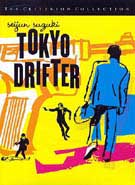
The Charge A Free-Jazz Gangster Film. Opening Statement Equal parts spaghetti western, Quentin Tarantino, Our Man Flint and Fellini fantasy, Tokyo Drifter fills the senses like a psychedelic acid trip through a carnival fun house. Large plot points are either missing or glossed over, and that's okay. Like eating a meal of Chicago-style Pizza followed by chocolate ice cream, Tokyo Drifter may not be perfect, but it sure is satisfying. Seijun Suzuki became an employee if Nikkatsu Studios because he made three times the amount his old studio paid per picture. After toiling through their system for many years and feeling unsatisfied, he began indulging his own desires to break out of that system and develop movies that challenged himself and his audience. As a result of this little rebellion, Suzuki was fired, left to toil through television and independent productions where he never recaptured the magic that created such interesting films as Tokyo Drifter and Branded to Kill. Given several million yen, and ordered to "play it straight" by Nikkatsu, Suzuki instead delivered Tokyo Drifter in 1966. The film performs a high-wire act of unbelievable proportion, continually stretching the boundary of believability while remaining entertaining through and through. That the entertainment comes from interesting color choices or camera angles and not from a dense or twisted plot matter not, as the film IS entertaining, which is all we could ask. To be sure, a plot is present, and it does have a moral center of sorts, preaching that perhaps it is indeed better to be self sufficient and independent rather than beholden to a person, an organization, a belief system. But the plot is so full of holes that it misses its mark often. Nevertheless, Tokyo Drifter stands as a bold achievement in filmmaking from the mid 1960s and it is presented here on DVD courtesy of The Criterion Collection, for all to enjoy. The Evidence Tokyo Drifter tells the story of Tetsu, the former right hand man to Kurata, a Japanese yakuza Boss now gone straight. As the story opens, Tetsu is wandering around the rail yards awaiting his death. Kurata calls him back to work in order to battle a rival gang. Tetsu looks up to Kurata as a father figure who has taught him everything he knows, and so obliges him. As the film unfolds, several men of the rival gang hunt Tetsu because he is seen as the lynchpin to destroying Kurata. Tetsu decides to leave Tokyo and Kurata because he views that as the only option that will help Kurata deal with the other gang. While in exile, Tetsu's loyalty is tested in many ways, none of which are as severe as the test he must face after returning to Tokyo. As mentioned above, Suzuki leaves gaping holes in the plot, but more than makes up for them with the style of the film. Tetsu parades around in his trademark powder blue suit for more than half the film. A primary set, used repeatedly throughout the shoot is a nightclub made up in a stark yellow. There are fascinating shots, such as the shot from showing two dead bodies from 40 feet dead above a false ceiling, a floor level shot of Tetsu kicking his gun across a floor, and one of the most interesting pans I have ever seen tracking a car coming around a corner. It all winds up being a bit disorienting at times, but still remains quite fascinating. Tetsu is a stone-faced killer with intelligence to spare. He has figured many of the rival gang's plans before they happen, but is blinded to his own betrayal by his loyalty. Tetsuya Watari plays Tetsu nearly perfectly, with the fluid movement of a dancer or large cat, he thwarts his foes while professing to remain a reformed gangster early in the film. But, he loses his temper wildly after being tested for a third time. Tetsu is one of the reasons the film has so much style and grace. The video and audio of this disc are pretty amazing, all things considered. The opening shot may scare you a bit, but it is clearly designed this way. It is completely over-saturated and overexposed. The shot looks more like a black and white cartoon than any kind of color film stock. The sky and water are a bright white while figures are a complete black, with nary a shade of gray in between. The rest of the film was shot in a brightly lit color, to emphasize the stark contrasts between good (powder blue suit) and evil (red shirt with blacker than black sunglasses). The audio is a solid mono track presented in the original Japanese with English subtitles optional. Dialog is clearly intelligible and the few music scenes have a decent dynamic range for the time period. The Rebuttal Witnesses The big drawback to the film is clearly the missing plot elements. Had the story been more complete, Tokyo Drifter would have been raised to a classic along the lines of Seven Samurai. As it stands it is more of a curiosity in terms of the style of the film, to be studied and enjoyed by a more select group of filmgoers. It is hard to lay blame for the missing plot points at the feet of Suzuki. As we learn during the one extra included on this disc, an interview with the man himself, the budget for these films was typically fairly low. But, probably the most important contributing factor to the lack of plot was the extraordinarily tight shooting schedule afforded the typical Nikkatsu production. Average shooting time was 25 days, with an additional three days allowed for editing and sound mixing. It is rather incredible that a film like this could be developed in such a short time frame. Closing Statement I highly recommend Tokyo Drifter to fans of film and DVD. If you are not familiar with Seijun Suzuki's work, I would probably rent this disc or Branded to Kill prior to a purchase. It may be a bit of an acquired taste, but what a taste it is!!! The Verdict Criterion is, as usual, acquitted of all charges for bringing Tokyo Drifter to market. Sure, a commentary track or two would have been a nice addition to this disc, but it stands pretty well on its own. Suzuki is thanked for a fascinating vision and creative camera shots, especially having done so in such a short time frame. Case Dismissed. Review content copyright © 2000 Sean McGinnis; Site layout and review format copyright © Share your thoughts on this review in the Jury Room
Similar Decisions: |

Printer Friendly Version |
||||||||||||||||||||||||||