|
Reviews |
Upcoming Releases |
Discussion Boards |
Staff Dossiers |
Studio Info |
Feedback |
All Content...
Most Popular | Best Rated | By Date | Random |
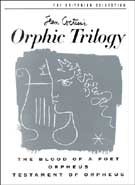
The Charge "This is not a film for judges." Opening Statement Jean Cocteau's last film, Testament of Orpheus, stands as a crucial retrospective of Cocteau's life and work, playfully examined by the artist himself. As one character remarks over the course of the film's dream-parade, "Jean Cocteau is a musician…who plays the buffoon." Testament of Orpheus is a fitting coda to both the Criterion Orphic Trilogy boxed set and the artist's career. Facts of the Case In the final scene of Orpheus, the Princess (Maria Casares) and Heurtebise (Francois Perier), having transgressed for the sake of love, are taken away to stand trial. The poet Cegeste is left behind, lost and alone. And so we begin Testament of Orpheus, or Do Not Ask Me Why, made 10 years after Orpheus. Cocteau himself, oddly dressed in courtier's garb (the result of a bet, we are told), appears as a ghost and haunts a scientist (Henri Cremieux). Cocteau is lost in spacetime, and only the professor's special faster-than-light bullets can release him from his plight. Once brought back to the present (and some normal clothes), Cocteau is met shortly thereafter by Cegeste (Edouard Dermithe) from Orpheus, who rises out of the sea to chastise Cocteau for leaving his fate unresolved. But Cegeste is older now (after all, "this is no longer a film; this is life," he tells us), and as the child of the artist (figuratively and literally, since Dermithe was Cocteau's adopted son), he has come to bring Cocteau before his judges: the Princess and Heurtebise. And even if the poet can pass that test, he must still face the goddess Athena, and offer her his only tribute: his art. The Evidence This film was the only part of the Orphic Trilogy I had not seen prior to this DVD release, and I was a little suspicious of it at first. After all, here is Cocteau starring in a retrospective of his own work: the risk of self-indulgence is great. But the result is remarkably candid and unpretentious. This is Cocteau at play, genuinely surprised at his own creativity and the wonderful contributions of his friends. "A wave of joy has carried my farewell film," he tells us at the end. Cocteau is an artist with nothing to prove: he merely takes pleasure in creation itself. Part mythological ritual (Cocteau's overriding motif is "phoenixology," "the art of repeatedly dying to be reborn), part personal response to his own artistic legacy, and even part science fiction (perhaps the new mythology?), Testament of Orpheus is, in Cocteau's words, "simply a machine for creating meanings." In keeping with the spirit of improvisation that marks much of his work, Cocteau gives himself over to his own unconscious. He creates stunning film images: reassembling a torn flower, elegant centaurs, his own death and resurrection at the hands of Athena. Jungians would have a field day with Cocteau's longtime obsession with the connection between mythology and psychology. But the film is far from stiff and remote: Cocteau is clearly having a great deal of fun. And he is not a bad actor either, constantly looking upon this world of his own making with childlike wonderment. Plenty of old friends drop by for this farewell performance too: Jean Marais, Charles Aznavour, Pablo Picasso, Brigitte Bardot, Yul Brynner, and others. Imagine if the Little Rascals, when putting on one of their hayloft theatricals to save the orphanage, were all brilliant, avant-garde artists. That is Testament of Orpheus in a nutshell: playful, sincere, and often profound in spite of itself. Criterion's digital transfer is nearly flawless. I would not have thought that a 40-year-old, low-budget "art film" could be kept in such excellent condition. There are virtually no nicks or scratches, and apart from a slight shimmer in a few scenes, the clarity of the black and white print (which does contain one brief color shot) is superior. The sound (and George Auric's luminous score) is clear and free of extraneous noise. As with the other discs in the Orphic Trilogy set, Criterion has done a fine job. And the extras? Essays galore: five short ones on the insert (plus a poem on "phoenixology"). One 3500 word (!) essay on the disc itself. But the big surprise is a 35-minute color film by Cocteau entitled "La Villa Santo Sospir." Shot in 1952, this is an "amateur film" done in 16mm, a sort of home movie in which Cocteau takes the viewer on a tour of a friend's villa on the French coast (a major location used in Testament of Orpheus). The house itself is heavily decorated, mostly by Cocteau (and a bit by Picasso), and we are given an extensive tour of the artwork. Cocteau also shows us several dozen paintings as well. Most cover mythological themes, of course. He also proudly shows paintings by Edouard Dermithe and Jean Marais and plays around his own home in Villefranche. This informal little project once again shows the joy Cocteau takes in creating art, in addition to showing a side of his work (his paintings and drawings) that his films often overshadow. The Rebuttal Witnesses Okay, I'm supposed to find something bad to say about the film here, right? Hmm. Um, well, there are a couple of minor glitches in the subtitling about halfway through the film. Other than that, there is absolutely nothing wrong with Testament of Orpheus. Of course, if you weren't sold on Jean Cocteau by either of my previous reviews (Blood of a Poet and Orpheus), I can do little to sway you here. While the "plot" of Testament of Orpheus depends on the viewer's familiarity with Cocteau's earlier work (especially Orpheus), the fact that Criterion packages all three films together in one box patches that hole right up. The complete set will set you back about $70 online. Damn Criterion for not making it available in vending machines for 25 cents a disc. There, did that sound sufficiently harsh? Closing Statement Are you still reading this? Go watch a Jean Cocteau movie (start with Orpheus or Beauty and the Beast if you still aren't sure). Stop saving your nickels for that collector's edition of Porky's Revenge and get yourself something worthwhile. The Verdict May the goddess Athena herself run the prosecutor through with her spear for continuing to bring this poet and his work before this tribunal. This court upholds the sentence handed down by the Princess and Heurtebise: Jean Cocteau, speaking through his art, is condemned to live. Review content copyright © 2000 Mike Pinsky; Site layout and review format copyright © Share your thoughts on this review in the Jury Room
Similar Decisions: |

Printer Friendly Version |
||||||||||||||||||||||||||