|
Reviews |
Upcoming Releases |
Discussion Boards |
Staff Dossiers & Blogs |
Studio Info |
Feedback |
All Content...
Most Popular | Best Rated | By Date | Random |
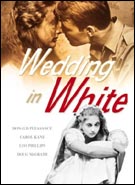
The Charge "She's in touble." Opening Statement The tremendous success of director Don Shebib's quintessential Canadian film Goin' Down the Road (1970) was due in no small measure to the original story and script by writer Bill Fruet. Fruet followed up with the slight Rip-Off (1971)—also a collaboration with Don Shebib. In 1972, however, he adapted his successful recent stage play for the screen and undertook the directing chores himself, producing what would eventually be awarded an Etrog (now known as the Genie award—the original Etrog title came from sculptor Sorel Etrog who designed the award statuette) as Canada's best film of the year—Wedding in White. The film has now been released on DVD by Ventura Distribution for Video Service Corporation as a 30th Anniversary Edition. Facts of the Case In small-town east-coast Canada during World War II, Jeannie Dougall is a 16-year old dropout living at home and seemingly facing a bleak future. Her father, Jim, lives on past army glories while currently working as a guard at a nearby prisoner of war camp. Her mother, Mary, is a long-suffering woman, old beyond her years. Her brother Jimmy, a loud-mouthed, cowardly lout, comes home on leave, bringing with him his army buddy Billy. After a night at the local legion hall spent drinking themselves into virtual oblivion, the men return home and Jim and his son fall into bed. Jeannie, temporarily evicted from her room, is sleeping on the living room couch when she is accosted later that night by Billy. When she resists his advances, he rapes her. The next morning, Billy and Jimmy steal away early from the house, after Billy has warned Jeannie not to say anything. Eventually, however, Jeannie realizes she is pregnant and tells her parents. Her father reacts violently to the situation, blaming Jeannie entirely for it. Desperate to avoid any public shame on the family name, he comes up with a decidedly unromantic solution. The Evidence Films dealing with the World War II home front, and made during the War, tended to be good-natured, nostalgic pieces intended to extol the virtues of the sort of happy home life soldiers were missing while away at war. Thus, a film like David Selznick's Since You Went Away (1944) ultimately left a good taste in the mouth despite the up and downs of the Claudette Colbert-led family along the way. The more realistic and sometimes bitter side of the home front started to be dramatized as time placed the War a respectable distance behind us. Particularly in Britain and Canada, there have been television efforts to shine a more accurate light on events at home. "Home Fires" was one such effort produced by the Canadian Broadcasting Corporation in the early 1980s. A decade earlier, the film Wedding in White presented a stark portrait of one Canadian family's home wartime experience. Without giving away the film's ending, it's at least fair to say that its solution to the family shame of one unwanted wartime pregnancy is at the very least distasteful. One might suggest that it's also unbelievable until you learn that Fruet's story and script reflect at least one similar real-life situation—the old story of truth being more unbelievable than fiction. There's very little uplifting about this bleak tale—a dysfunctional family headed by a mean-spirited father whose chief pastime seems to be getting drunk along with his friends; a mother who's had the life and looks sucked out of her at too young an age by a life starved of emotion and material comfort; a young daughter of apparently limited intellect and confidence who appears to have nothing in life to look forward to; a drunken loud-mouth of a son who's basically a coward; the son's friend who devotes his time to smoking, drinking, raping the daughter, and then running away; a dog whose life consists of being chained up in the basement and being taunted whenever he's fed—and all set in a dispiriting home and legion hall neighbourhood of decay and neglect. In order to balance this bleakness, a truly extraordinary cast takes the material and makes it come startlingly alive and believable, even to the most minor character and event. Equally impressive are veteran actor Donald Pleasance as the father and a young Carol Kane as Jeannie. Carol Kane has to have one of the most distinctive and expressive faces in the business—large, sunken, sad eyes in a thin face surrounded by a mass of unruly long hair shooting out in all directions. The result is a perfect embodiment of the Jeannie character, reflecting both Jeannie's inward-looking nature as well as the inevitable sadness that seems destined to always be her lot in life. Donald Pleasance, with his usual scene-stealing mannerisms and minor prop manipulations present but in check, nails the father with a complex blend of good and bad. On one hand, there's the image of barely-restrained, drink-induced anger that always seems just on the verge of taking itself out violently on his wife or daughter. On the other, his evident pride in his organizational efforts at the local legion hall—the parents' only apparent source of entertainment—is almost sad given that the location is usually the starting place for his drinking sessions. In the smaller roles of Jimmy and Billy, Paul Bradley and Doug McGrath evoke memories of their work as the two main characters in Goin' Down the Road. We always wondered what might have been their characters' future. Well, it's easy to imagine that they might have turned to the army and ended up as the sort of deadbeats portrayed in Wedding in White. Bradley's and McGrath's efforts are both solid in this film. Worth noting is the film's attention to period detail—costuming and vernacular appear fully consistent with the times—and especially its look. Director Fruet films in colour, but presents a very subdued palette that conveys the film's mood and drab setting effectively. More importantly, it doesn't make the mistake of so many wartime colour recreations that overemphasize brightness and vibrancy—thus playing false with most people's memories of the period. Fruet also has an eye for effective composition with some very interesting camera positioning. The opening shots of the dog's basement home are immediately arresting and later become moreso as one realizes the parallels with Jeannie's life. The closing sequence lingers in the memory also. The Wedding in White DVD is distributed by Ventura on behalf of the Canadian company Video Service Corporation. On the surface, the image looks fairly good. It captures the drab colouring accurately while maintaining sharpness for the most part. Some of the darker scenes are noisy and lacking in shadow detail. More troubling, however, is the fact that this is a full screen transfer while the film was apparently shot in Panavision (2.35:1), according to the on-screen credits. This is most evident in the horizontal framing, which often seems tight, suggesting that the transfer has simply chopped off the edges of the original composition. A Dolby Digital 2.0 stereo sound track gives quite a satisfactory rendering of the dialogue-driven story. There is no subtitling or closed captioning. The key supplement is an entertaining and informative audio commentary that takes the form of an interview of Carol Kane by Jonathan Gross (the president of Video Service Corporation). Gross is sufficiently versed in the film's background to be able to provide useful prompting to Kane as the film proceeds. Kane provides a wealth of detail on all aspects of production interspersed with personal stories about this film as well as other career work. She comes across as genuinely appreciative of the opportunity the film afforded her early in her career, as well as enthusiastic about participating in the commentary. Other supplements include short biographies of Kane, Pleasance, and Fruet, and a short photo gallery. Closing Statement Wedding in White was a worthy award winner 30 years ago and still stands up well today. Its virtues include a fine script, excellent performances, and thoughtful direction—always a potent combination. Unfortunately, the DVD effort, despite the inclusion of a fine commentary by Carol Kane, is less than satisfactory. Full screen presentations of widescreen films are unacceptable to informed film enthusiasts, even if they don't appear to compromise the image dramatically. The Verdict The court doesn't want to convict the defendant given the film's intrinsic value, but it does hold co-conspirator Ventura/Video Service Corporation accountable for DVD presentation inadequacies. Review content copyright © 2003 Barrie Maxwell; Site layout and review format copyright © Share your thoughts on this review in the Jury Room
Similar Decisions: |

Printer Friendly Version |
||||||||||||||||||||||||||