|
Reviews |
Upcoming Releases |
Discussion Boards |
Staff Dossiers & Blogs |
Studio Info |
Feedback |
All Content...
Most Popular | Best Rated | By Date | Random |
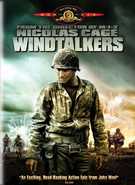
Editor's Note Our review of Windtalkers: Director's Edition, published May 20th, 2003, is also available. The Charge "Begging the Major's pardon, but I believe I best serve the Corps killing Japs, not babysitting some Indian."—Corporal Joe Enders Opening Statement During World War II, the Japanese proved extremely adept at breaking any code the American fleet in the South Pacific threw at them. Their skill at code breaking gave them an enormous tactical advantage both on land and at sea until, in February of 1942, the son of a missionary to the Navajo tribe named Philip Johnston showed the United States Navy they could develop a code from the Navajo language. Because the language was unique and unwritten, it would prove impossible for the Japanese to decipher. By September of 1942, the Code Talker program was a reality. Between 300 and 400 Navajo worked as code talkers during the war, relaying coded tactical information via radio transmissions. Their efforts saved the live of thousands of American soldiers. Facts of the Case After seeing horrific action in the Solomon Islands where he nearly lost his life to a Japanese grenade, Corporal Joe Enders (Nicolas Cage) is promoted to sergeant and paired with Navajo code talker Ben Yahzee (Adam Beach) for a bloody Marine campaign in Saipan. Enders' problem is that his assignment is to protect the Navajo code, not Yahzee. Meaning, he must kill his partner before allowing him to fall into enemy hands. Enders struggles to maintain emotional distance from Yahzee, while the young man impresses him as he develops into a skilled and courageous soldier. The Evidence If nothing else, Windtalkers is a study in the way the jarringly graphic aesthetics of Steven Spielberg's Saving Private Ryan have forever changed the Hollywood war picture. Director John Woo (Face/Off) has adopted much of the visceral impact that is the hallmark of Spielberg's film—the whizzing bullets, metal-on-metal ricochets, thunderous explosions, grit, gore, severed limbs, and general chaos of armed combat—while largely leaving behind the emotional wallop that comes from knowing real young men experienced such real horrors (as opposed to the sort, choreographed by Hollywood directors with multi-million dollar budgets, that allow us to enjoy them as entertainment). What Windtalkers doesn't borrow from Saving Private Ryan is the washed-out look of battle footage shot on 16mm film at 12 frames per second with little cameras in the center of the action, splattered with mud and shaken by nearby explosions, making one feel like a war correspondent on the scene. The battle scenes in Woo's film are more traditionally handled, shot with Panavision Steadicams, producing a warmer, more color-saturated look, and a stable image that provides us emotional distance. This isn't necessarily a bad thing—known as an action director, Woo delivers a film with battle scenes that run significantly longer than those in Spielberg's film, take up a much larger percentage of the film's total running time, and are filled to the brim with acts of derring-do. To've filmed them the same way as Saving Private Ryan would've left audiences strung-out, sweaty, and probably tossing their cookies. Whether or not you like Windtalkers will depend largely on your opinion of good old-fashioned Hollywood war pictures. Despite its veneer of politically correct subject matter, this is not a movie with a much of a message. Sure, it serves to remind us of the courage displayed by soldiers in the performance of difficult and frightening tasks, as well as their amazing willingness to sacrifice their lives for their brothers-in-arms, but mostly it hopes to entertain us with high-octane action set pieces. This is not a film that invites meditation on the evil, necessity, or horror of war. If produced in another era, one could imagine John Wayne replacing Nicolas Cage in the role of Sergeant Joe Enders. Grizzled and hardened, a marine to the core of his soul who trudged his way through a frustrated and meaningless existence until he found himself in the arena of combat, we know he'll never be able to return to civilian life, marry, have kids; he's a killing machine, a stereotype. Most of the characters in the film are stereotypes, culled from a long tradition of war movies. Like the no-name "redshirt" ensign beaming with Kirk and Spock to the planet's surface on any number of episodes of Star Trek, one knows many of the soldiers in Windtalkers are there to die, and one knows who they are long before their final moments come. That the characters are stereotypes isn't a problem if you like the war film genre. Woo and screenwriters John Rice and Joe Batteer (Blown Away) are simply using the age-old technique of shorthanding everything we need to know about the characters so Woo can get on with the action. The cast is packed with strong actors who do a fine job with the material they're given. In addition to strong performances from Cage and Beach, the film boasts talent like Christian Slater, Peter Stormare (Fargo), Noah Emmerich (The Truman Show), and Jason Isaacs (The Patriot). They all play their roles with skill and complete seriousness, probably having a blast playing the sort of battle-hardened, single-minded soldiers they watched in movies like Sands Of Iwo Jima and The Longest Day when they were kids. The fact the film tanked at the box office is likely an indication it's out of its time, culturally speaking. We expect war films to be reflective and somber, to explore human psychology, and bring us face to face with war's toll in lives. Windtalkers takes seriously a soldier's duty, and it doesn't make light of death, but its action sequences have the same emotional depth as those in xXx or any other action-for-action's-sake film, which is to say none at all. The movie isn't bad; it simply suffers from comparison to more textured and complex modern war films like Saving Private Ryan or Ridley Scott's Black Hawk Down. It would work better in another time—the past definitely, perhaps someday in the future—but not today. Windtalkers is presented on DVD in beautiful fashion. MGM has treated the film well, supplying both widescreen anamorphic and full screen transfers on opposite sides of a DVD-18 (a dual-sided, dual-layered disc). Let's talk widescreen: the transfer is from a pristine print of the film and is pretty near reference quality. Colors are bold and warm and natural, as intended by Woo and cinematographer Jeffrey L. Kimball (Star Trek: Nemesis). Softness in very isolated shots is the only real problem with the transfer, and it's minor. The full screen transfer is a bit of an oddity: pan-and-scan in some sections and open matte in others, since parts of the movie were shot anamorphically at a 2.35:1 ratio, while others were shot with the Super 35 process at 1.66:1, then matted to 2.35:1 for theatrical presentation. The full screen version is as pristine as the widescreen, but who cares? It's full screen. The Dolby Digital 5.1 Surround track is muscular, but also has lots of subtle depth. Dialogue is clearly presented across the front soundstage, while bullets whiz past your head and mortar explosions and air support give your subwoofer plenty to contend with. It's a fun track, and well designed—sound effects are always well-positioned, so it enhances the viewing experience without feeling intentionally showy. Other than a handful of trailers, there are no extras on the disc. This is really not a surprise considering the film's box office performance. The Rebuttal Witnesses Just a few humble words of advice to MGM: boldly advertising the film as being "from the director of Mission: Impossible 2" is not the way to whet most filmgoers' appetites for it. Closing Statement If you're looking for a war film that sheds any pretense of philosophical exploration, keeps you on the edge of your seat with frequent and intense action sequences, and doesn't leave you bummed out as the credits roll, you've found it. If your idea of a good war film is Apocalypse Now or Black Hawk Down, films that make you think about the reality of war and its toll on human lives and psyches, you'll probably want to take a pass on Windtalkers. The Verdict Windtalkers is what it is, which is slightly less than most audiences would like. Based on that, I find the film not guilty, but based on the fact it's got a price tag in the $20 range for a disc with no extras, I recommend you stay away. It's worth a rent, but save your dough and buy Band of Brothers if you want to own a moving war epic. Review content copyright © 2002 Dan Mancini; Site layout and review format copyright © Share your thoughts on this review in the Jury Room
Similar Decisions: |

Printer Friendly Version |
||||||||||||||||||||||||||